Multiple End Event
Ends the path throwing SEVERAL results at once — e.g. a message and a signal. Thick circle with a filled pentagon.
The Multiple End Event bundles result-throwing: on termination it emits all its defined results (message + signal, message + escalation…). It compresses what would otherwise be a chain of throw events before a plain end.
When to use and avoid
When to use
When finishing must notify a participant and broadcast simultaneously.
To keep diagram endings compact when multiple results are genuinely simultaneous.
When the set of results is fixed and small.
When NOT to use
When results should happen in a meaningful order — chain explicit throw events instead.
When only one result exists — use its dedicated end event.
When compactness hurts readability — explicit events teach better.
Business example
Reply to the requester and announce completion
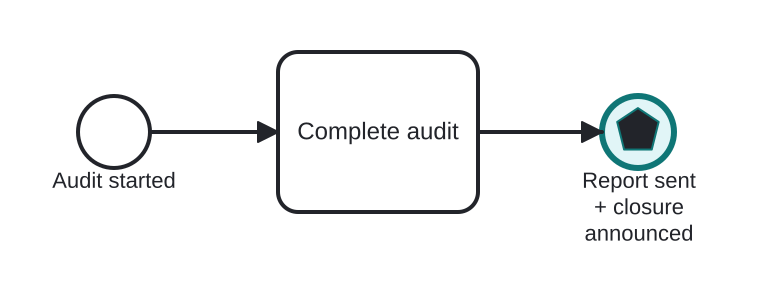
Open this example in the HEFLO process editor and explore the diagram from the inside.
Open in the HEFLO editor →Step by step
- Complete audit finishes the engagement.
- The Multiple End Event (highlighted, filled pentagon) simultaneously sends the report message to the requesting area and broadcasts the “audit closed” signal to subscribing processes.
- The instance ends with both results emitted.
Differences
Multiple End vs chained throws + None End
Semantics are equivalent when order doesn't matter; the chained version shows each result explicitly and allows ordering. Prefer explicitness unless the diagram is drowning in endings.
FAQ
Which result types can be combined?
Any throwable results: message, signal, escalation, compensation, error… all fire upon reaching the event.
Is there a catching Multiple End?
No — end events only throw. The catching multiple exists at start and intermediate positions.