Signal Start Event
Starts the process when a broadcast signal is caught. Thin circle with a triangle icon. Signals have no specific addressee — anyone listening reacts.
The Signal Start Event subscribes the process to a broadcast: when someone throws the signal (from any process), every listener starts an instance. It decouples publisher from subscribers — the thrower doesn't know who reacts.
When to use and avoid
When to use
For company-wide events with many independent reactions: “price table published”, “campaign launched”, “system maintenance announced”.
When new subscriber processes should be addable without touching the publisher.
To fan out one business fact into several processes at once.
When NOT to use
For one-to-one communication with a known recipient — that is a Message.
Inside a single process to jump between branches — use Link Events or restructure the flow.
When the reaction must be guaranteed and acknowledged — broadcasts have no delivery confirmation semantics.
Business example
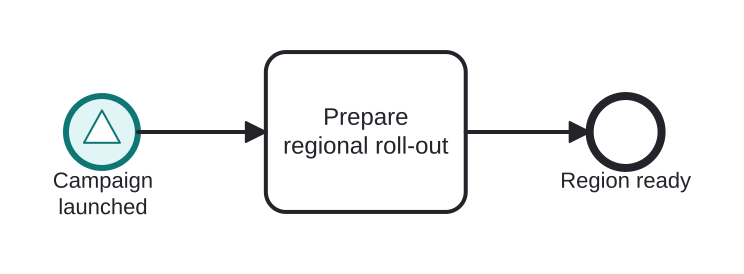
Regional processes react to a campaign launch
Open this example in the HEFLO process editor and explore the diagram from the inside.
Open in the HEFLO editor →Step by step
- Marketing throws the signal “Campaign launched” somewhere else in the organization.
- The Signal Start Event (highlighted) catches the broadcast and starts this region's preparation process — every other region does the same, independently.
- The instance ends with the region ready.
Differences
Difference between Signal and Message
A Message is addressed point-to-point between two participants. A Signal is a broadcast: no addressee, any number of listeners (including zero). One-to-one conversation → Message; publish/subscribe → Signal.
FAQ
Can one signal start several different processes?
Yes — that is its purpose. Every process with a matching Signal Start Event creates an instance.
Does the thrower know who reacted?
No. Signals are fire-and-forget broadcasts; if the publisher needs acknowledgment, use messages.