Intermediate Conditional Event
Pauses the flow until a business condition becomes true. Double thin circle with a lined-paper icon.
The Intermediate Conditional Event is a data-driven wait: instead of waiting for a message or a clock, the token waits for state — “continue when the account balance is positive”, “proceed once headcount is approved”.
When to use and avoid
When to use
To gate progress on a data condition with no explicit notifier.
When some other process/system updates the state and yours just observes it.
For wait-until semantics that would otherwise need polling loops.
When NOT to use
When a notifier exists — a Message (addressed) or Signal (broadcast) is more explicit and efficient.
For time-based waits — Timer.
When nobody actually monitors the condition in the implementation.
Business example
Waiting until stock is available
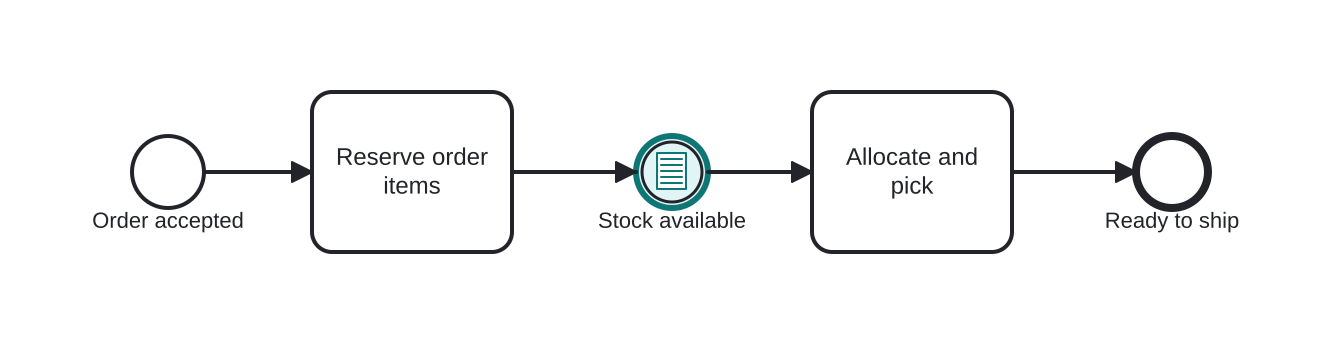
Open this example in the HEFLO process editor and explore the diagram from the inside.
Open in the HEFLO editor →Step by step
- Reserve order items finds insufficient stock.
- The Conditional Event (highlighted) waits until
stock ≥ requiredbecomes true — replenishment happens elsewhere. - When the condition holds, Allocate and pick continues the fulfillment.
Differences
Conditional vs Signal catch
A Signal needs someone to throw it; a Condition is evaluated over data with no thrower. If the fact is announced, catch the signal; if it is silently reflected in data, use the condition.
FAQ
How often is the condition checked?
Conceptually, whenever relevant data changes. Engines implement it via data-change triggers or periodic evaluation — check your tool.
What if the condition is already true when the token arrives?
Then the event fires immediately — the token passes through without waiting.