Intermediate Timer Event
Pauses the flow for a duration, until a date, or until the next occurrence of a cycle. Double thin circle with a clock icon.
The Intermediate Timer Event is BPMN's *wait here*: cooling-off periods, legal deadlines, retry pauses. The token sits at the event until the timer fires, then continues.
When to use and avoid
When to use
For mandated waiting periods (e.g. a 7-day cooling-off before charging).
To schedule the next step at a specific time (send reminders at 09:00).
For polite retry pacing between attempts to reach an external system.
When NOT to use
To time-limit an activity — that is a Timer Boundary Event on the activity.
To start a process on schedule — Timer Start Event.
To model waiting for an external answer — waiting for stimuli is a Message/Signal catch, not a timer.
Business example
Cooling-off period before charging
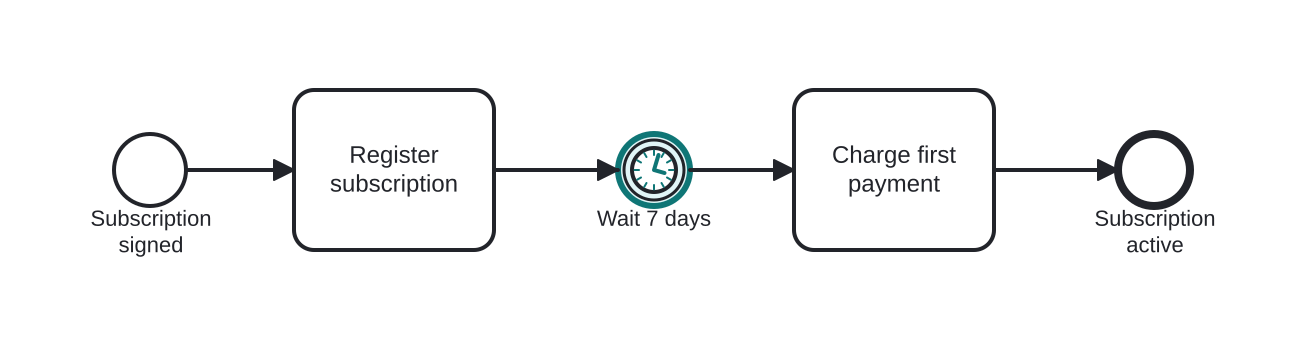
Open this example in the HEFLO process editor and explore the diagram from the inside.
Open in the HEFLO editor →Step by step
- The customer signs up and Register subscription completes.
- The Intermediate Timer Event (highlighted) holds the token for the 7-day cooling-off period required by policy.
- After the period, Charge first payment runs.
Differences
Intermediate Timer vs Timer Boundary
The intermediate timer is a deliberate pause on the path — everything waits. The boundary timer supervises an activity — it fires only if the activity is still running when the deadline hits. Pause → intermediate; deadline/SLA → boundary.
FAQ
Is the timer catch-only?
Yes. Time cannot be 'thrown'; timer events exist only in catching positions (start, intermediate catch, boundary).
Can the duration be dynamic?
Yes — engines accept expressions (e.g. a variable holding the number of days) in the timer definition.