Intermediate Escalation Throw Event
Raises an escalation to a higher scope (typically the parent process) without terminating the current flow. Double thin circle with a filled upward arrowhead.
Escalation is BPMN's non-fatal severity channel: a child scope signals “I need attention up there” while (unlike an error) allowing work to continue. A parent catches it with an Escalation Boundary Event or an event sub-process.
When to use and avoid
When to use
When a sub-process must alert its parent (e.g. approval taking too long) without aborting.
For management-by-exception patterns: normal flow continues, supervisor path activates in parallel.
To distinguish 'needs attention' from 'failed' (which is an Error).
When NOT to use
For failures that must abort the scope — throw an Error.
To communicate with another participant — escalations do not cross Pool boundaries; use a Message.
For broadcasts to unknown listeners — Signal.
Business example
Escalating a delayed approval to the supervisor
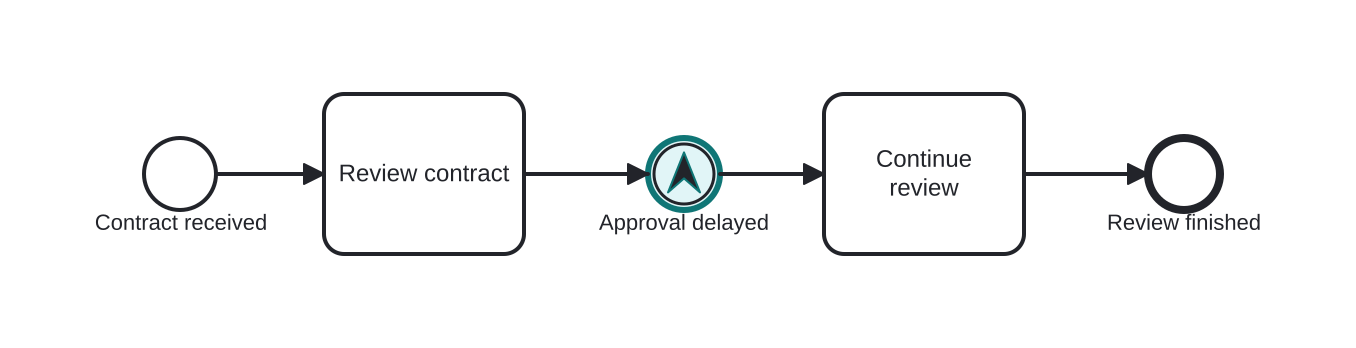
Open this example in the HEFLO process editor and explore the diagram from the inside.
Open in the HEFLO editor →Step by step
- Review contract is dragging past the internal target.
- The Escalation Throw Event (highlighted, filled arrowhead) raises “approval delayed” to the parent scope — and the flow continues to Continue review.
- In the parent, an escalation catcher activates the supervisor's intervention path in parallel.
Differences
Escalation vs Error
Error = fatal for the scope: the flow stops and must be handled. Escalation = severity signal: the flow may continue, and the catcher is typically non-interrupting. Choose by whether the scope can keep working.
FAQ
Who catches an escalation?
An Escalation Boundary Event on the enclosing sub-process/activity, or an escalation-started event sub-process in a parent scope.
Can an escalation cross to another Pool?
No — it travels up scopes within the same process. Between participants, use messages.