Intermediate Compensation Throw Event
Triggers the compensation handlers of already-completed activities — the BPMN way to “undo” finished work. Double thin circle with filled rewind arrows.
Business work often can't be rolled back like a database transaction — a booked hotel must be *cancelled*, a charged card must be *refunded*. The Compensation Throw Event invokes the compensation handlers (attached via compensation boundary events) of activities that already completed, in reverse order.
When to use and avoid
When to use
When a late failure requires undoing earlier completed steps (cancel bookings, reverse postings).
In sagas / long-running transactions where classic rollback is impossible.
Paired with compensation boundary events that define *how* each activity is undone.
When NOT to use
When nothing was completed yet — just route to an end.
For technical retries of a failing step — that is error handling, not compensation.
When a Transaction Sub-Process with a Cancel End already orchestrates the undo — don't double-trigger.
Business example
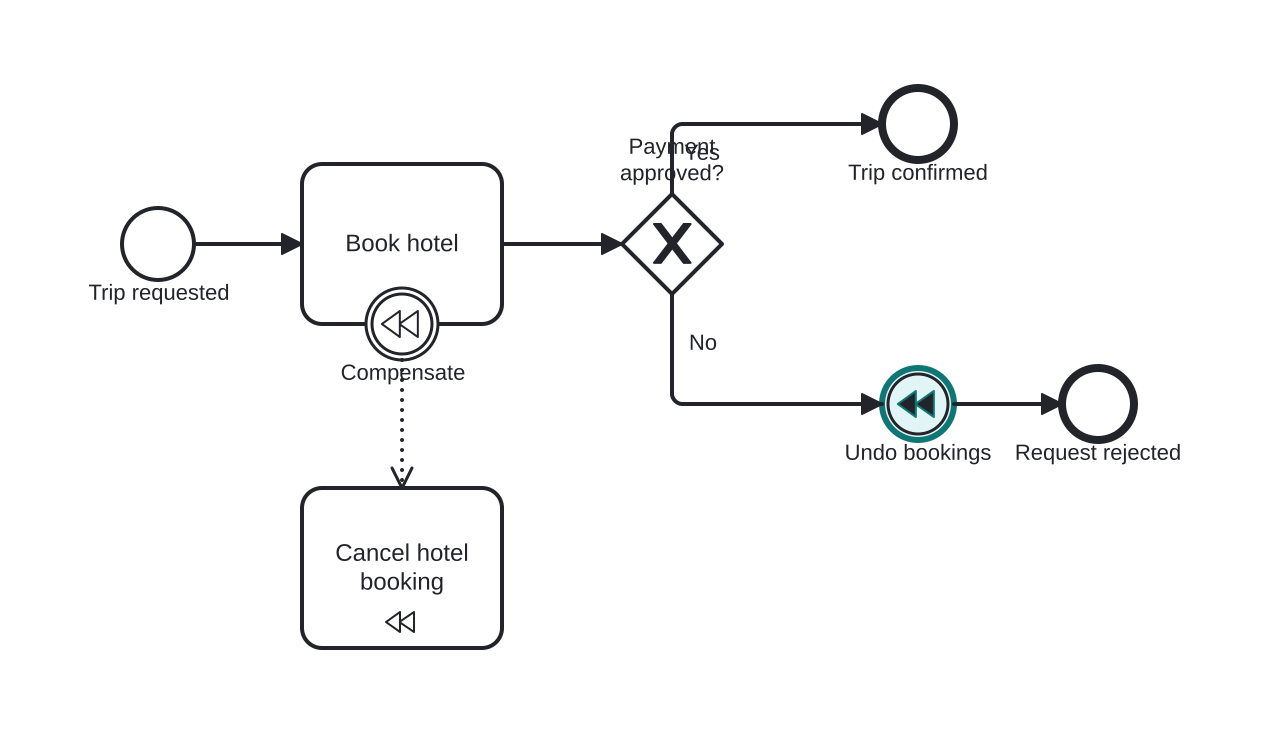
Undoing a hotel booking after payment is declined
Open this example in the HEFLO process editor and explore the diagram from the inside.
Open in the HEFLO editor →Step by step
- Book hotel completes; its compensation boundary + handler “Cancel hotel booking” define how to undo it.
- Payment is declined at the gateway.
- The Compensation Throw Event (highlighted) fires — the engine invokes the handler of the completed booking, cancelling it — and the process ends with the request rejected.
Differences
Compensation vs Error
Error handles *this* failing step. Compensation undoes *previous successful* steps because a later condition invalidated them. They usually work together: an error triggers the path that throws compensation.
FAQ
In what order are handlers executed?
Reverse order of completion — the most recently finished activity is compensated first, like unwinding a stack.
Do activities without a compensation handler get undone?
No — compensation only reaches activities that declared a handler via a compensation boundary event.