Signal End Event
Ends the path while broadcasting a signal to whoever listens. Thick circle with a filled triangle.
The Signal End Event finishes the path and announces it to the world: any process with a matching signal catcher reacts. It turns a process's completion into a reusable business fact — “onboarding finished”, “batch closed” — without knowing who cares.
When to use and avoid
When to use
When completion is a fact other processes subscribe to.
To chain processes loosely: finish here, others start or resume on the broadcast.
As the final act of publishing state changes with multiple consumers.
When NOT to use
To answer a specific requester — Message End.
When no listener will ever exist — a None End with a good name is enough.
Mid-flow — that is the intermediate Signal Throw.
Business example
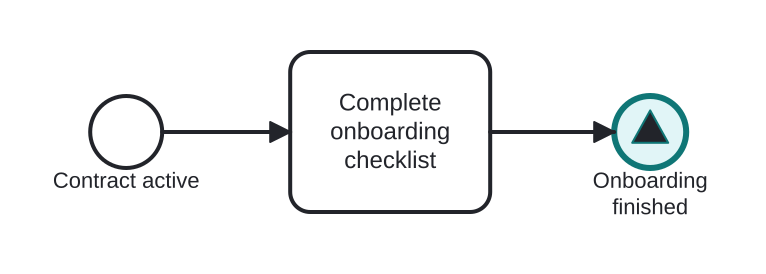
Broadcasting that onboarding finished
Open this example in the HEFLO process editor and explore the diagram from the inside.
Open in the HEFLO editor →Step by step
- Complete onboarding checklist wraps up the new customer.
- The Signal End Event (highlighted) ends the process and broadcasts “onboarding finished”.
- Billing, CRM enrichment and welcome-campaign processes each catch the signal and proceed independently.
Differences
Signal End vs Message End
Message End addresses one known participant. Signal End broadcasts to any number of unknown listeners. Response → message; announcement → signal.
FAQ
Do listeners get the signal if they subscribe later?
No — signals are not stored. Only processes already waiting (or with signal starts deployed) react.
Can several processes start from this one signal?
Yes — every deployed process with a matching Signal Start creates an instance.