Link Intermediate Throw Event
The sending half of a link pair: the token 'jumps' from here to the matching Link Catch. Double thin circle with a filled arrow.
The Link Throw Event is the exit door of a visual go-to: it consumes the token at this point in the diagram, and the matching catch (same name, same process level) re-emits it elsewhere. Together the pair replaces a long connector.
When to use and avoid
When to use
To break a long flow across diagram rows or printed pages.
To avoid sequence flows crossing dozens of elements.
As paired signposts (“Continue A” → “Continue A”) that readers follow easily.
When NOT to use
To jump between processes, Pools or sub-process levels — not allowed.
To simulate loops sneakily — an explicit flow back or a loop marker is clearer.
When there is nothing to gain in readability.
Business example
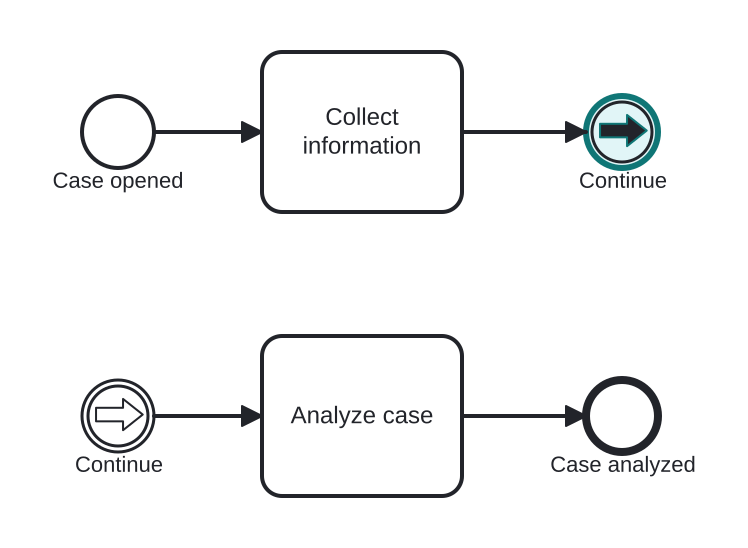
Jumping from row 1 to row 2
Open this example in the HEFLO process editor and explore the diagram from the inside.
Open in the HEFLO editor →Step by step
- After Collect information, the token reaches the Link Throw “Continue” (highlighted).
- It disappears here and reappears at the matching Link Catch on the row below.
- The flow resumes with Analyze case.
Differences
Link Throw vs other throw events
Every other throw (message, signal, escalation…) *communicates* something. The Link Throw communicates nothing — it is pure diagram navigation. Don't expect engines to emit anything.
FAQ
Do link events appear in execution logs?
Typically as trivial pass-through steps or not at all — they have no business meaning.
Are link events allowed at start or end positions?
No — links exist only as intermediate throw/catch pairs.