Business Rule Task
A task that delegates a decision to a business rules engine — typically a DMN decision table — and returns the result to the process. Marked with a table/grid icon.
The Business Rule Task (Business Rule Task) separates decision logic from process flow. The process says *when* a decision happens; the decision table says *how* it is made.
This separation is powerful: pricing rules, eligibility criteria and discount policies change far more often than the process around them. With a Business Rule Task, business analysts update the decision table (often in DMN — Decision Model and Notation, the OMG's companion standard to BPMN) without touching or redeploying the process model.
When to use and avoid
When to use
For decisions governed by business rules that change frequently: eligibility, pricing, risk classification, discount tiers.
When business users should be able to maintain the rules themselves in a decision table.
When the same decision is reused by several processes — one decision table, many callers.
When NOT to use
For simple one-off routing logic — conditions on a gateway's outgoing flows are enough.
For technical calculations that never change with business policy — a Script Task is simpler.
When a human must exercise judgment — that is a User Task, not a rules engine.
Business example
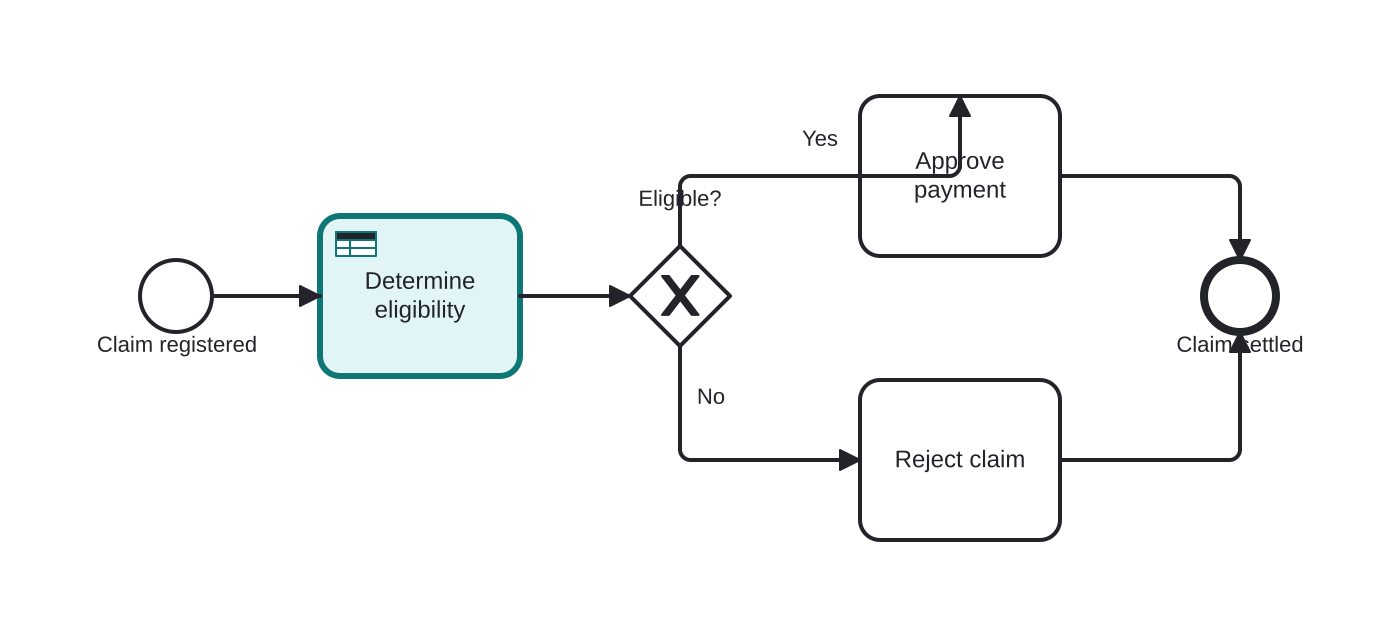
Determining insurance claim eligibility
Open this example in the HEFLO process editor and explore the diagram from the inside.
Open in the HEFLO editor →Step by step
- The process starts when a claim is registered.
- The Business Rule Task “Determine eligibility” (highlighted) invokes a DMN decision table that crosses policy type, coverage and claim value — and returns *eligible* or *not eligible*.
- The Exclusive Gateway routes accordingly: Approve payment or Reject claim.
- Both paths conclude the process.
When the eligibility policy changes, only the decision table is edited — the process diagram stays untouched.
Differences
Difference between a Business Rule Task and a Script Task
Both are automatic, but the Business Rule Task externalizes the decision into a table/rules engine that business users can maintain and audit, while the Script Task hard-codes logic inside the model. Policy-driven decisions → Business Rule; technical glue → Script.
Difference between a Business Rule Task and a decision on a Gateway
A Gateway routes tokens based on data that already exists; it does not *compute* anything. The Business Rule Task produces the decision data (e.g. eligible = true) that a following gateway then routes on. The pair 'rule task + gateway' is the canonical decision pattern.
FAQ
Do I need DMN to use a Business Rule Task?
No — the BPMN spec only says the task invokes business rules. DMN is the natural companion standard and the most common implementation, but any rules engine qualifies.
Who maintains the decision tables?
Ideally business analysts, not developers — that is the point of the separation. Governance (versioning, testing, approval of rule changes) becomes a business responsibility.