Exclusive Gateway
A decision point that routes the flow down exactly ONE of several paths, based on condition evaluation. BPMN's exclusive-or (XOR) split. Diamond, optionally with an X.
The Exclusive Gateway evaluates its outgoing conditions in order and sends the token down the first one that is true — never more than one. Always give it a default flow (marked with a slash) so the token can't get stuck when no condition matches.
Used as a join, it simply lets each arriving token pass — it does not synchronize.
When to use and avoid
When to use
When the process must follow exactly one of mutually exclusive paths (Approved? yes/no).
To reconverge alternative paths that never run in parallel (exclusive merge).
When the decision uses data already available in the instance.
When NOT to use
When several paths may run at the same time — Parallel (AND) or Inclusive (OR).
When the choice depends on an external event (message vs timeout) — Event-Based Gateway.
As a synchronizer of parallel branches — an exclusive join lets each token straight through.
Business example
Credit decision by amount
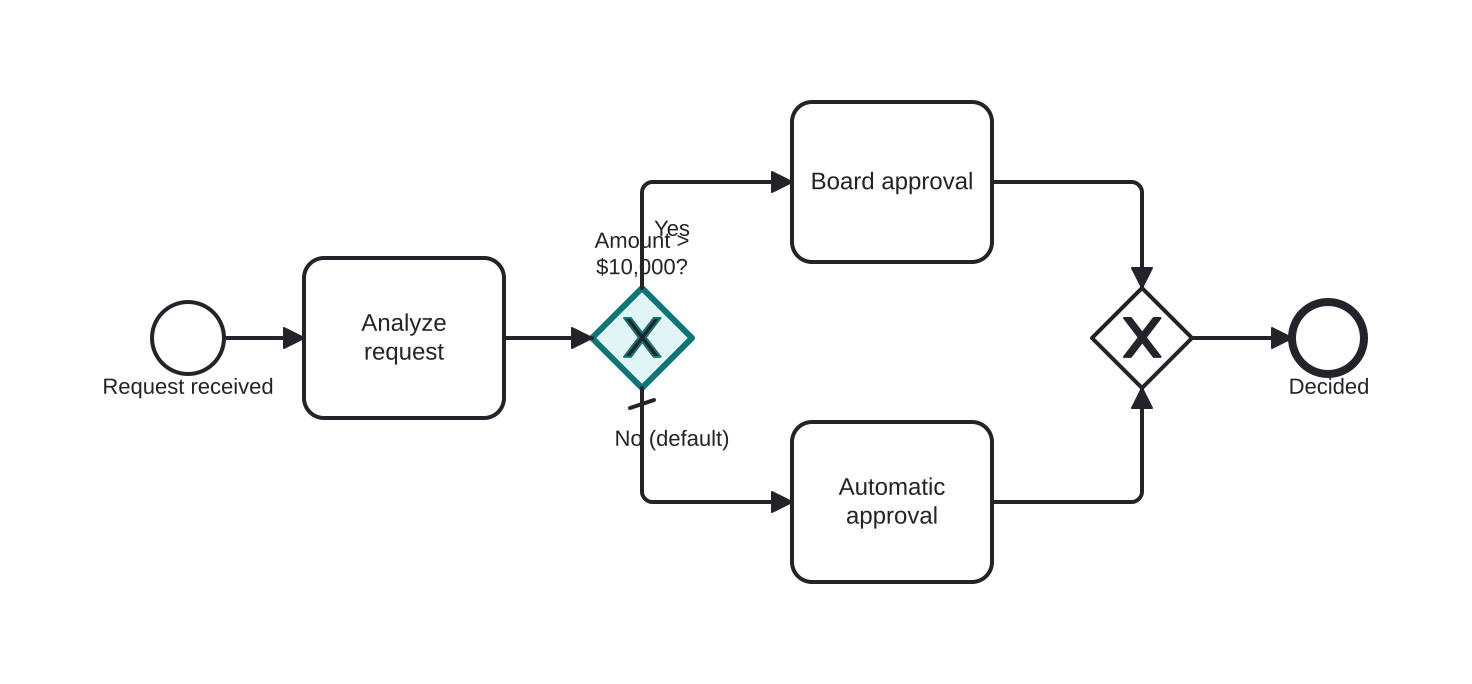
Open this example in the HEFLO process editor and explore the diagram from the inside.
Open in the HEFLO editor →Step by step
- After Analyze request, the token reaches the Exclusive Gateway (highlighted) “Amount > $10,000?”.
- True → Board approval; otherwise the default flow goes to Automatic approval.
- Exactly one path is taken; both later merge to the same end.
Differences
Exclusive vs Event-Based Gateway
Exclusive decides on data, immediately. Event-Based decides on which event happens first — the process waits. Internal decision → exclusive; race between external stimuli → event-based.
Exclusive vs Inclusive Gateway
Exclusive (XOR) takes exactly one path. Inclusive (OR) activates every path whose condition is true — one, several or all — and its join waits only for the activated ones.
FAQ
What if no condition is true?
With a default flow, the token takes it. Without one, the model is broken — the token deadlocks. Always model the default.
Is the X marker required in the diamond?
Optional per spec — but recommended for readability, and most tools draw it.