Ad-hoc Sub-Process
A sub-process whose inner activities have no prescribed order — performers choose what to execute, in which sequence, possibly in parallel. Marked with a tilde (~).
The Ad-hoc Sub-Process embraces knowledge work: the model lists *what can be done* (draft sections, review, consult specialist) without dictating sequence. A completion condition — “all mandatory sections done” — decides when the sub-process finishes.
It is the honest way to model creative or investigative segments that resist rigid sequencing.
When to use and avoid
When to use
For knowledge-work segments: preparing proposals, investigations, case research.
When performers legitimately decide order and repetition of the available actions.
To document the *menu* of permitted activities with an explicit completion criterion.
When NOT to use
When order actually matters — model the flow explicitly.
As an excuse to avoid analyzing the process — check whether a real sequence exists first.
For automation-heavy segments — engines need deterministic structure to drive work.
Business example
Drafting proposal sections in any order
Open this example in the HEFLO process editor and explore the diagram from the inside.
Open in the HEFLO editor →Step by step
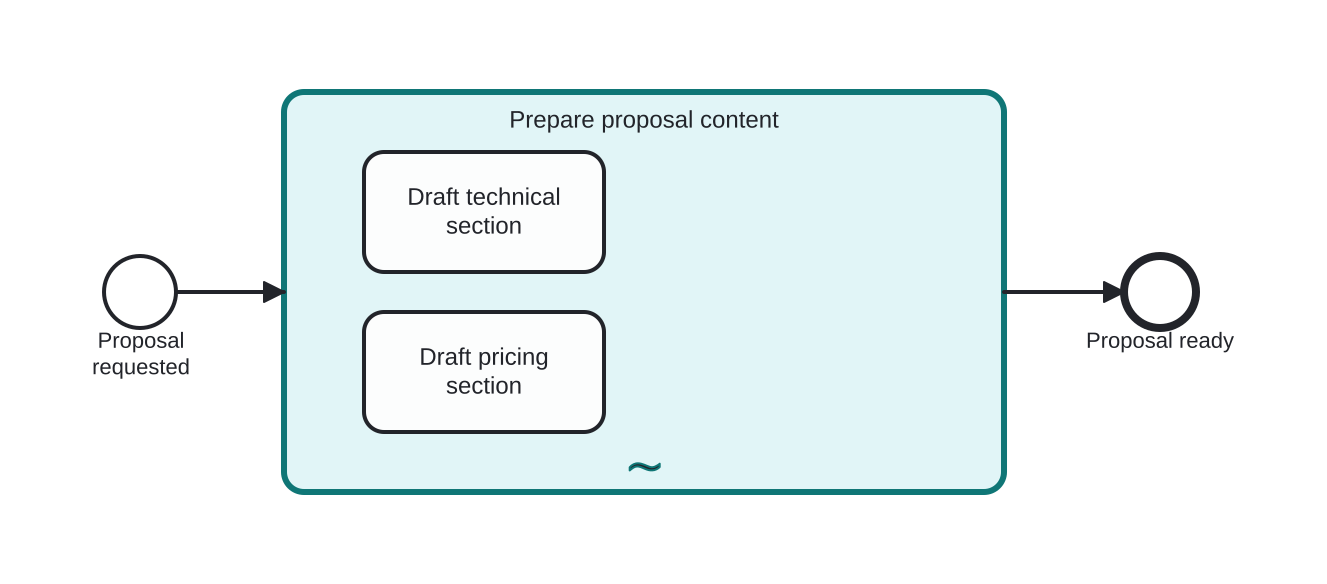
- The Ad-hoc Sub-Process (highlighted, ~ marker) offers two activities: draft the technical section, draft the pricing section.
- The team performs them in any order, possibly in parallel, repeating as needed — no arrows dictate sequence.
- When the completion condition (all sections drafted) holds, the sub-process ends and the proposal is ready.
Differences
Ad-hoc Sub-Process vs parallel gateway fan-out
A parallel fan-out runs all branches exactly once, mandatorily. The ad-hoc leaves choice, order and repetition to humans, bounded by a completion condition. Prescribed concurrency → gateway; discretionary work → ad-hoc.
FAQ
Can flows exist inside an ad-hoc sub-process?
Partial ordering is allowed — you may connect some activities while leaving others free.
How do engines support it?
Support varies widely; many treat it as a checklist of startable activities with a completion condition. Verify your tool.