BABOK for Process Analysts: Connecting Business Analysis, BPM and Automation

Many process improvement projects start with a diagram.
A team maps the current workflow, identifies a few delays, redesigns the process, and quickly moves toward automation. On the surface, this seems efficient. But without clear business analysis, the team may automate the wrong process, solve the wrong problem, or miss the requirements that actually determine whether the solution will work.
This is where BABOK becomes useful for process analysts.
BABOK, the Business Analysis Body of Knowledge, is not a BPM methodology and it is not a process modeling notation. It is a guide for understanding business needs, stakeholders, requirements, change, solutions, and value. For process analysts, those ideas are extremely practical.
A strong process analyst does more than draw workflows. The role connects business problems with process logic, stakeholder expectations, operational constraints, measurable outcomes, and, when appropriate, automation.
In other words:
BABOK helps process analysts understand what the business needs. BPM helps structure how work should happen. BPMN helps express that process clearly. Automation helps execute it with control and visibility.
When these pieces are connected, process improvement stops being mere documentation and becomes a path from business need to operational performance.
Why process analysts should understand BABOK
Process analysts often work at the intersection of business operations, technology, compliance, service quality, and continuous improvement. They interview stakeholders, document current processes, identify bottlenecks, propose future-state workflows, define responsibilities, and support automation initiatives.
That work is very close to business analysis, and BABOK gives process analysts a structured way to think before modeling or automating. Instead of starting with “What does the process look like?”, the analyst can start with better questions:
- What business need is driving this process change?
- Which stakeholders are affected?
- What requirements must the future process satisfy?
- What constraints should shape the process design?
- What value should the solution deliver?
- How will success be measured after implementation?
These questions help avoid a common mistake in BPM projects: treating the process model as the starting point. A BPMN diagram is powerful, but it should represent a business understanding that has already been clarified, and BABOK helps create that understanding.
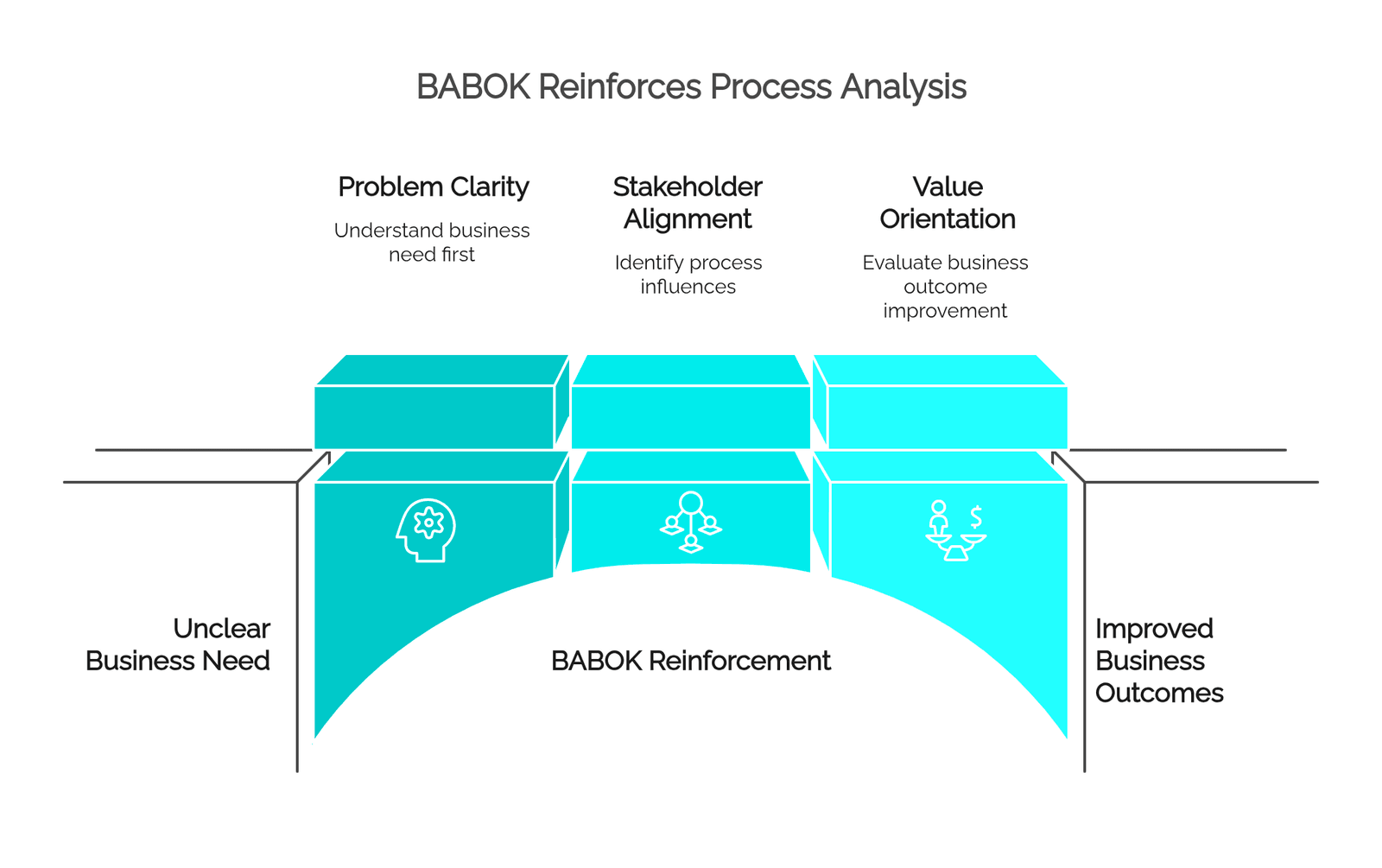
For process analysts, BABOK is especially useful because it reinforces three disciplines:
- Problem clarity: understanding the business need before proposing a process change.
- Stakeholder alignment: identifying who influences, performs, approves, receives, or governs the process.
- Value orientation: evaluating whether the implemented solution actually improves business outcomes.
Business analysis and process improvement
Process improvement is not only about removing steps, reducing handoffs, or making work faster. Those things matter, but they are not enough. A process can become faster and still fail the business if it ignores compliance rules, customer expectations, data quality, audit requirements, or stakeholder responsibilities.
Business analysis keeps process improvement connected to purpose. A useful initiative usually starts with a concrete business need, such as:
- reducing the cycle time of purchase approvals
- improving employee onboarding consistency
- increasing visibility in a shared services operation
- reducing rework in invoice processing
- improving compliance in contract review
- standardizing service requests across departments
- reducing dependency on informal knowledge
From there, the process analyst investigates the current state, identifies gaps, defines future-state requirements, and designs a process that can deliver the expected value. This is where BPM and business analysis reinforce each other: business analysis clarifies the need and requirements, BPM structures the process lifecycle, BPMN translates the process into a visual model, and automation executes the design with tasks, rules, forms, deadlines, alerts, and traceability.
How stakeholders shape processes
Processes are not neutral. They reflect the expectations, responsibilities, constraints, and decisions of different stakeholders, and each one may see the same process differently.
A simple approval workflow, for example, may involve:
- the requester, who submits the demand and wants speed and transparency
- the manager, who approves the request and wants fewer follow-ups
- finance, which validates budget and wants spending control
- procurement, which negotiates with suppliers and wants standardization
- compliance, which defines control requirements and wants traceability
- IT, which manages integrations and wants secure, maintainable architecture
- the process owner, who monitors performance
- executives, who expect visibility and governance
A process analyst who understands BABOK concepts does not treat these perspectives as noise; they become part of the analysis. Stakeholder analysis helps answer questions such as: who provides information to the process, who makes decisions, who performs the work, who is affected by delays, who owns the process, who approves changes, who needs visibility into performance, and who defines business rules, controls, and exceptions.
When stakeholder expectations are ignored, the process model may look correct but fail in execution. When they are understood, the design becomes more realistic, useful, and easier to govern.
This stakeholder view maps directly onto BPMN, and the accounts payable process below makes the distinction visible.
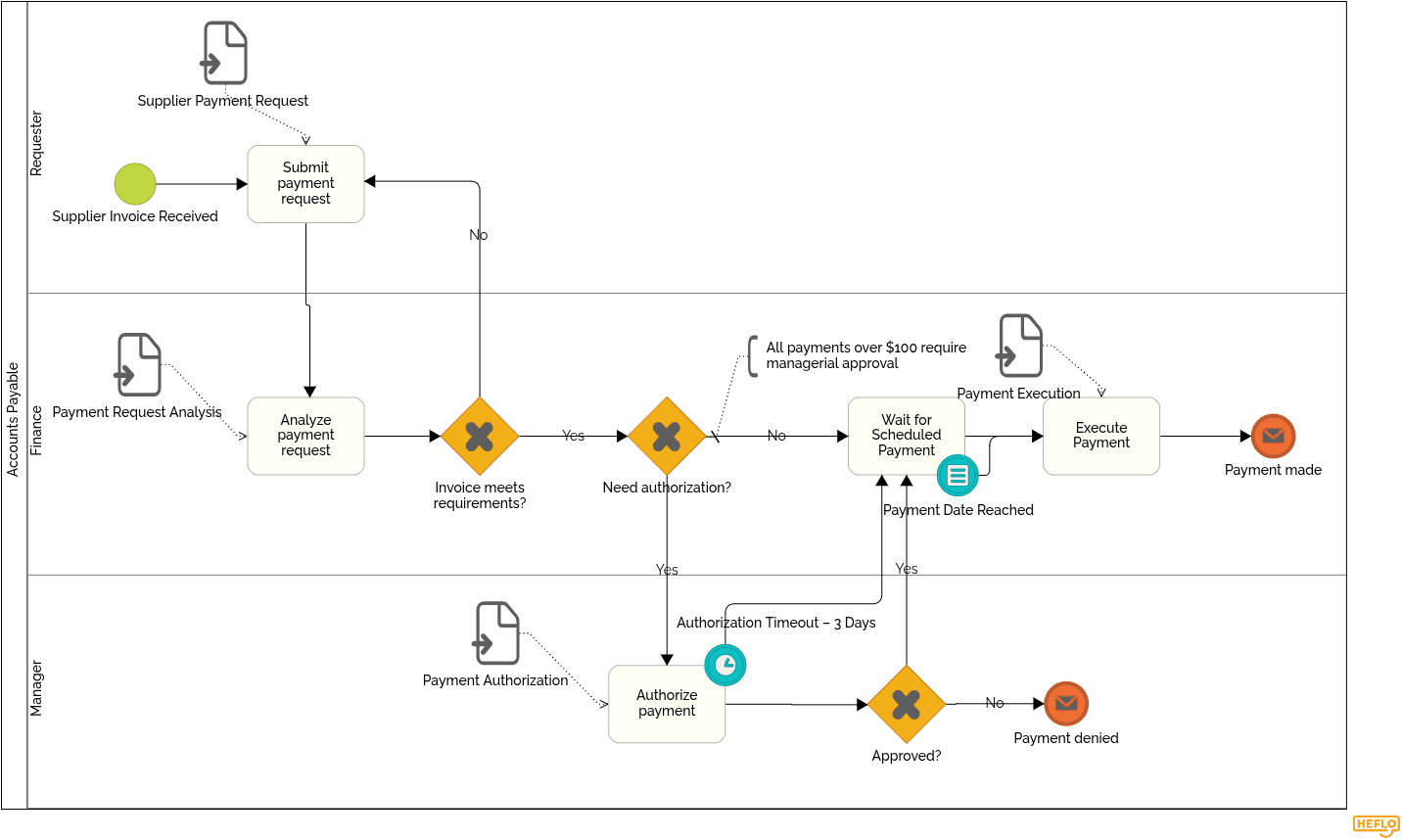
Stakeholders who perform work in the process become lanes. Here the Requester (Supplier) submits the payment request, Finance analyzes it and executes the payment, and the Manager authorizes payments that require approval — three roles, three lanes, each one making its responsibilities visible in the diagram.
How requirements affect process design
Requirements are not separate from process design; they shape it. A requirement may determine which task exists, who performs it, what data is required, which rule applies, what deadline must be respected, which system must be integrated, or which exception path must be available.
| Requirement | Process design impact |
|---|---|
| Requests above $10,000 require finance approval | Add a gateway based on request value |
| Incomplete requests must return to the requester | Add validation and correction paths |
| Legal must review contracts with non-standard clauses | Add conditional routing to legal review |
| Managers must be alerted before an SLA is missed | Add deadline rules and alert triggers |
| All approvals must be auditable | Capture decision history, user, date, and comments |
| Requesters need status visibility | Publish process status through a portal |
| ERP data must be validated before approval | Add integration or data verification step |
This is why requirements analysis matters before BPMN modeling. Without requirements, the model becomes a visual guess. With them, the BPMN diagram becomes a structured representation of what the business actually needs the process to do.
Process analysts should pay special attention to requirements related to roles and responsibilities, business rules, approval criteria, forms and required data, deadlines and SLAs, exceptions and escalations, compliance and audit trail, integrations with other systems, reporting and performance indicators, and the customer or internal client experience. These requirements later become process logic.
Why processes should not be automated before analysis
Automation does not fix an unclear process; it usually makes the unclear process move faster. This is one of the biggest risks in business process automation. When teams automate before analysis, they may preserve unnecessary steps, reinforce poor handoffs, hard-code weak rules, or create workflows that are difficult to change later.
Before automation, process analysts should understand why the process exists, what problem needs to be solved, which outcomes matter, where delays and errors occur, which variations are legitimate, which exceptions need controlled paths, which rules should guide routing, what data each decision requires, which activities add value, and how performance will be measured.
The reason is simple: automation turns process decisions into operational behavior. If the analysis is weak, automation can create more control problems than it solves. If the analysis is strong, automation helps the organization execute the process with consistency, visibility, and traceability.
How BPMN helps translate requirements into process models
BPMN gives process analysts a visual language for representing how work happens. Requirements can be translated into BPMN elements such as:
- tasks for activities that must be performed
- events for process starts, endings, messages, timers, and triggers
- gateways for decisions and conditional paths
- lanes for responsibilities and roles
- subprocesses for reusable or detailed parts of the process
- data objects for information required during execution
- boundary events for exceptions, timeouts, or alternate behavior
A requirement that “requests must be approved by finance when the value exceeds a threshold” becomes a gateway. A requirement that “the requester must be notified when documentation is incomplete” becomes an exception path. A requirement that “approval must happen within two business days” becomes a timer or deadline rule.
This is the bridge between BABOK and BPMN: BABOK clarifies the need, stakeholders, requirements, constraints, and expected value, while BPMN expresses the process logic that responds to them. A good BPMN model should not only show sequence; it should also make visible the decisions, responsibilities, exceptions, and controls the business requires.
How BABOK supports better process governance
Process governance is not only about approving diagrams. It is about controlling how process knowledge, changes, responsibilities, requirements, and performance expectations are managed over time. BABOK concepts support governance because they encourage analysts to manage requirements, stakeholders, decisions, and change in a structured way.
For BPM teams, this matters in situations such as:
- a process changes because a regulation changes
- a department requests a new approval rule
- a manager wants to remove a step another stakeholder considers mandatory
- an automation rule needs to be updated
- a new system integration changes the process flow
- a process owner needs evidence of why a change was approved
- different business units follow different versions of the same process
Without governance, documentation becomes outdated and automation becomes difficult to maintain. With governance, teams can define who owns the process, who can request changes, who approves requirements, how versions are controlled, how stakeholders are informed, and how performance is reviewed.
This is especially important once a process is automated, because a change is no longer just a documentation update. It can affect task routing, deadlines, approvals, integrations, audit trails, dashboards, and user experience. BABOK helps process analysts approach that change with more discipline.
Solution evaluation: connecting automation with business value
A process automation project should not end when the workflow goes live. The real question is whether the solution is delivering value, and solution evaluation answers it by connecting the implemented process with business performance.
For process analysts, useful evaluation questions include whether the process reduced cycle time, whether fewer requests are delayed, whether approval bottlenecks decreased, whether users submit complete information, whether rework is lower, whether SLAs are respected, whether managers gained visibility, whether exceptions are handled with more control, whether the process is easier to audit, and whether stakeholders are satisfied with the new way of working.
This is where automation becomes measurable. A workflow platform can generate operational data such as task completion time, waiting time, approval time, number of open requests, overdue tasks, exception frequency, and process volume. But the analyst still needs to connect those metrics to the original business need. Automation is not valuable just because work is digital; it is valuable when it improves speed, quality, control, compliance, visibility, cost, or service experience.
Practical example: from business need to BPMN model to automation
Imagine a shared services team responsible for purchase requests. Today the process runs through email and spreadsheets. Requesters send demands to managers, who approve by email. Finance checks budget later. Procurement sometimes receives incomplete information. Requesters chase status updates because they cannot see where a request is, and managers only discover delays after someone complains.
1. Business need
The organization wants to reduce delays, improve visibility, standardize approvals, and create a reliable audit trail for purchase requests. This is the business need — not yet a process design.
2. Stakeholders
The analyst identifies the main stakeholders: employees who request purchases, managers who approve them, the finance team responsible for budget validation, the procurement team responsible for supplier and negotiation steps, the compliance team responsible for audit requirements, the IT team responsible for ERP integration, and the process owner responsible for performance. Each contributes requirements.
Watch our short video on stakeholder analysis to see how to map these roles in practice.

3. Requirements
After analysis, the team defines practical requirements:
- Requesters submit purchase requests through a structured form including value, cost center, supplier, justification, and attachments.
- Requests below a defined value require manager approval only; requests above the threshold also require finance approval.
- Procurement reviews supplier information before order creation.
- Incomplete requests return to the requester.
- Approvers receive automatic notifications, and approval tasks have deadlines.
- Delayed requests trigger escalation.
- Requesters can track status, and every approval decision is recorded.
- The process owner monitors cycle time, delays, and bottlenecks.
4. BPMN model
The analyst translates the requirements into a BPMN model:
- Start event: purchase request submitted
- Task: validate request information
- Gateway: information complete? (return path to the requester if not)
- Task: manager approval
- Gateway: approved?
- Gateway: value above threshold?
- Task: finance approval
- Task: procurement review
- Task: create purchase order
- End event: request completed
- Timer rules: approval deadline and escalation
- Exception paths: rejected request, incomplete information, missing supplier data
The model now shows more than a flow — it shows business rules, decisions, responsibilities, and exceptions.
To explore each of these elements in depth, see our complete guide to BPMN notation.
5. Automation
Once the process is clear, automation can assign tasks, route approvals, apply rules, notify users, control deadlines, escalate delays, record decisions, and generate performance data. A platform such as HEFLO supports this stage: after the business analysis is clear, it helps teams model the BPMN process, document responsibilities and rules, publish approved process knowledge, automate execution, and monitor performance. The analyst does not need to turn every change into a software project, while IT remains important for architecture, integrations, identity, security, and technical standards.
See our video lesson on automating processes with HEFLO to watch these steps in action.
6. Solution evaluation
After implementation, the team evaluates results such as average request cycle time, percentage of overdue approvals, returned requests due to missing information, requests by department, approval bottlenecks, SLA compliance, requester satisfaction, and audit readiness. This closes the loop from business need to measurable value.
Where HEFLO fits in this journey
HEFLO is most useful after business analysis has clarified what the process should achieve. It helps teams move from process understanding to operational control across key parts of the BPM lifecycle: modeling processes with BPMN; documenting tasks, rules, responsibilities, and details; publishing approved process knowledge; managing versions and governance; automating workflows with forms, rules, approvals, deadlines, and routing; monitoring execution and performance; and improving the process based on operational data.
This connection matters because a diagram alone does not ensure people follow the process, a document alone does not control execution, and a simple automation tool may route tasks but fail to preserve governance. For process analysts, the value lies in connecting these layers: analysis, model, documentation, governance, execution, and improvement. HEFLO should not replace business analysis — it should make the results of good analysis easier to model, share, execute, and improve.
From process documentation to execution
Your process analysts already know how work should move. HEFLO helps them turn that knowledge into executable BPMN workflows with rules, approvals, deadlines, exceptions, and traceability.
Explore process analyst automationPractical checklist for process analysts
Before modeling or automating a process, ask:
- What business need is driving this initiative?
- What problem are we solving?
- Who are the stakeholders, and what does each need from the process?
- What requirements must the future process satisfy?
- What business rules affect routing or decisions?
- What information is required at each step?
- What exceptions need controlled paths?
- What metrics will show whether the process improved?
- What should be governed before the process changes again?
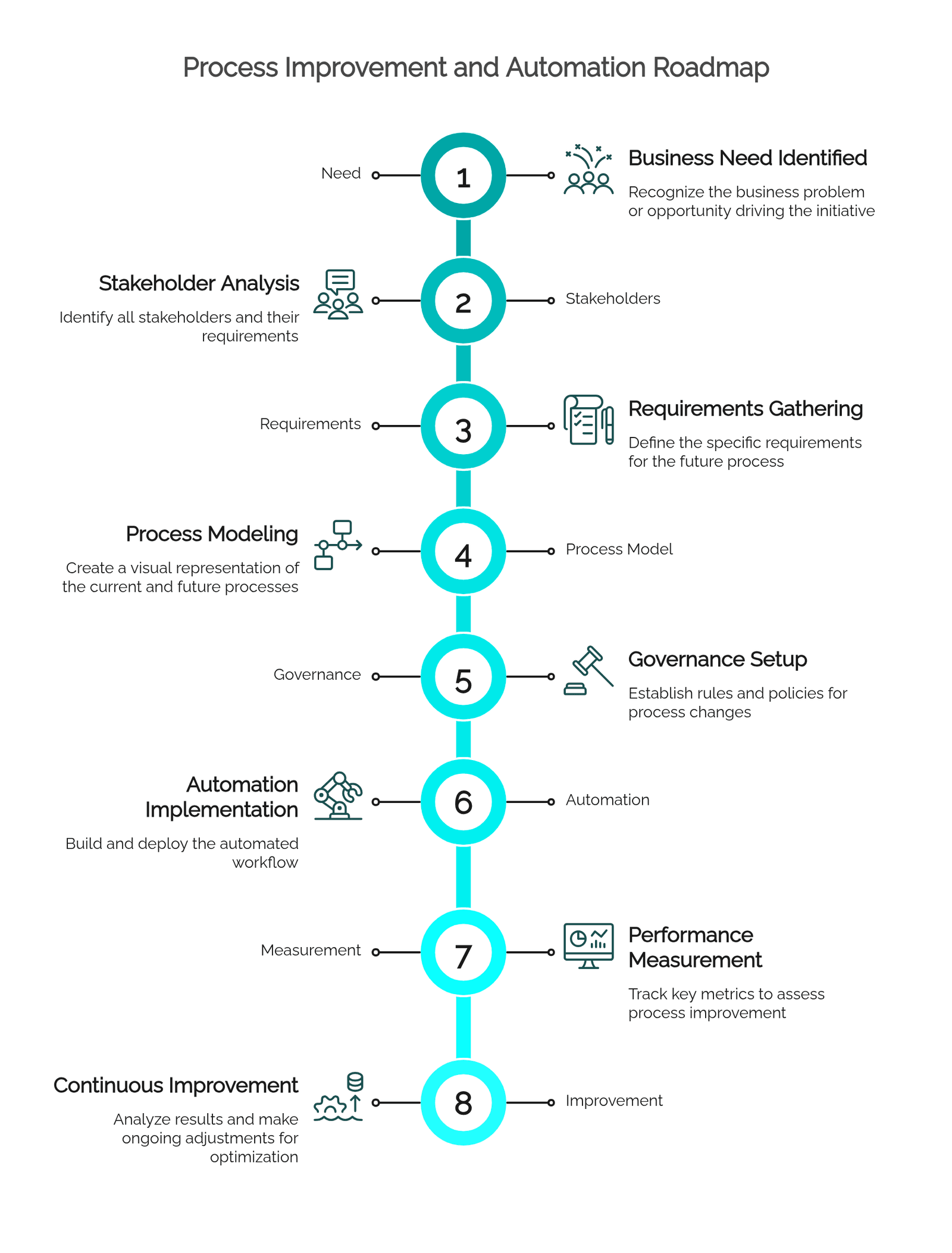
These questions make process work more reliable and prevent the team from jumping too quickly from “we need automation” to “let’s build a workflow.” The better path is:
Conclusion
BABOK is valuable for process analysts because it strengthens the thinking behind process work. It helps analysts avoid diagram-first or automation-first approaches and instead start with the business need, stakeholders, requirements, constraints, and expected value. BPM then structures the lifecycle, BPMN provides the visual language to model the process, and automation executes it with rules, responsibilities, deadlines, traceability, and performance data.
The real opportunity is not to choose between business analysis, BPM, BPMN, and automation, but to connect them. When that connection is clear, process improvement becomes more credible, automation becomes safer, and business value becomes easier to measure.
FAQ: BABOK for Process Analysts
What is BABOK for process analysts?
BABOK provides business analysis concepts that help clarify business needs, stakeholders, requirements, solutions, change, and value. Process analysts use these concepts to design better processes before modeling or automating them.
How does BABOK relate to BPM?
BABOK explains what the business needs and why change is required, while BPM structures how processes are modeled, governed, executed, monitored, and improved. Together they connect business analysis with process improvement and operational execution.
Is BABOK the same as BPMN?
No. BABOK is a guide for business analysis knowledge and practices; BPMN is a graphical notation used to model business processes. BABOK clarifies needs and requirements, and BPMN represents the process flow that responds to them.
Why should process analysts define requirements before creating a BPMN model?
Requirements shape the model, defining responsibilities, rules, approvals, data, deadlines, exceptions, integrations, and performance expectations. Without them, a BPMN model may look complete but fail to reflect what the business actually needs.
How can BABOK improve process automation?
By helping teams analyze the business need, stakeholders, requirements, constraints, and expected value before automation begins, BABOK reduces the risk of automating unclear, inefficient, or poorly governed processes.
What BABOK concepts are most useful for BPM teams?
The most useful include business needs, stakeholders, requirements, designs, change, value, requirements life cycle management, elicitation, strategy analysis, requirements analysis, and solution evaluation.
Why should processes not be automated before analysis?
Because automation turns process decisions into operational behavior. If the process is unclear, automation can reinforce poor handoffs, weak rules, unnecessary steps, and unmanaged exceptions.
How does solution evaluation connect automation with business value?
It checks whether the implemented process or automation is delivering the expected value, using measures such as cycle time, SLA compliance, rework, bottlenecks, user adoption, cost, quality, visibility, and compliance.
Can HEFLO help connect BABOK, BPMN and automation?
Yes. HEFLO helps teams apply the results of business analysis by modeling processes in BPMN, documenting requirements and responsibilities, publishing approved process knowledge, automating workflows, and monitoring performance.
Do process analysts need to be business analysts to use BABOK?
No. The concepts benefit anyone who needs to understand business needs, stakeholders, requirements, process change, and solution value, regardless of formal title.