Data Output
Data the process DELIVERS to the outside when it completes — the formal output parameter of the process. Data-object shape with a filled arrow marker.
The Data Output is the other half of the process contract: *when I finish, I hand back this* — the issued policy, the assessment report, the approval decision. Together with Data Inputs it defines the process's interface, essential for processes invoked by Call Activities.
When to use and avoid
When to use
To document what a reusable process returns to its callers.
To design caller/called data mapping for Call Activities.
To make process deliverables explicit in governance documentation.
When NOT to use
For intermediate artifacts that stay inside — Data Objects.
For writes into persistent systems — that interaction points to a Data Store.
Purely decorative usage in high-level maps.
Business example
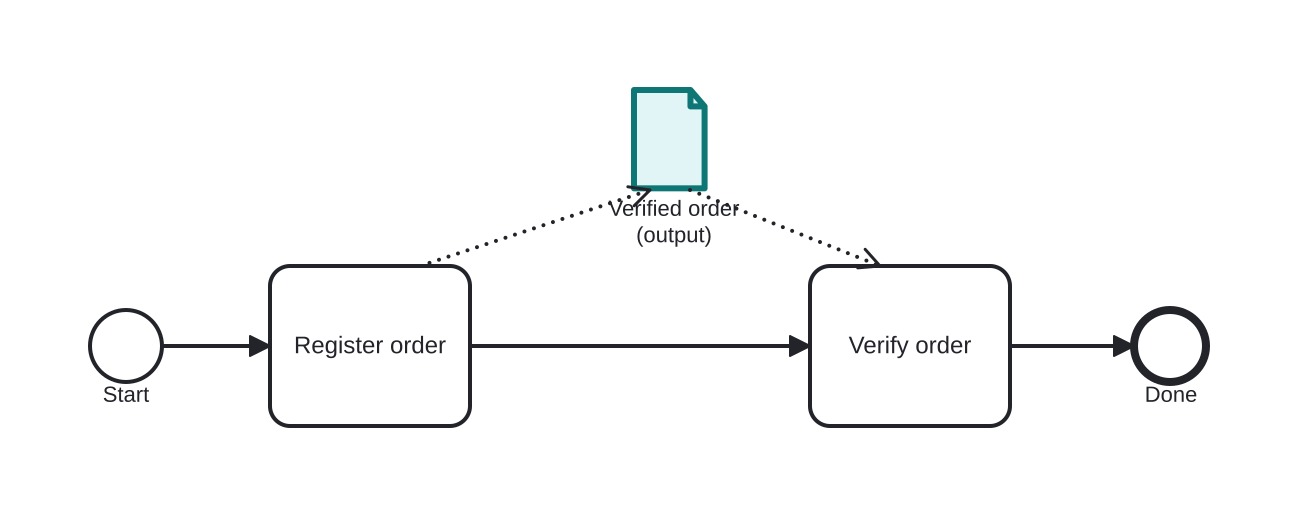
The verified order as the declared output
Open this example in the HEFLO process editor and explore the diagram from the inside.
Open in the HEFLO editor →Step by step
- The final task produces the highlighted artifact — the process's deliverable.
- At completion, this Data Output is what the caller (or the environment) receives back.
- Formally it carries a filled-arrow marker and lives in the process's output set (rendered here as the equivalent data artifact).
Differences
Data Output vs Message End Event
A Data Output returns data through the process interface (to a caller). A Message End sends a message to *another participant*. Function-style return → output; communication → message.
FAQ
Who consumes a process's Data Output?
The invoker: a Call Activity maps it back into the parent's variables; an engine API returns it to the caller application.
Can a process have several outputs?
Yes — the output set may contain multiple data outputs, each mapped independently.