What Is an Internal Customer?

When we think of “customers,” we usually imagine external people buying our products or services. But within every organization, there are internal customers — employees and departments that rely on others to get their jobs done.
Ignoring their needs can silently sabotage your productivity, collaboration, and even customer satisfaction.
But what exactly is an internal customer? And how can managing this relationship improve your entire business operation?
What Is an Internal Customer?
An internal customer is anyone inside your organization who depends on your work to succeed in theirs.
This includes:
- Departments receiving services from IT, HR, or Finance.
- Colleagues waiting for approvals, documents, or support.
- Teams involved in shared workflows or cross-functional projects.
When HR requests the Finance team to process payroll, HR becomes an internal customer. Similarly, a sales manager requesting marketing materials is an internal customer of the Marketing team.
Real-Life Examples of Internal Customer Relationships
Internal customers exist in every organization — whether you're a small startup or a global enterprise. They are colleagues, departments, or teams that depend on your work to succeed in theirs.
Here are some typical scenarios:
- HR & IT Collaboration
When the HR team needs to onboard a new employee, they rely on IT to set up accounts, devices, and access to essential systems. In this case, HR acts as an internal customer of IT.
👉 Curious to see how this internal customer relationship works in practice?
We’ve prepared a visual example of an Employee Onboarding Process Diagram that illustrates how HR and IT collaborate step by step — from initial request to successful onboarding. - Marketing & Finance Interaction
Before launching a campaign, the marketing department often needs budget approvals from finance. The Finance team becomes a critical internal service provider, and Marketing, its internal customer. - Sales & Legal Teams
The sales team frequently needs support from the legal department to review contracts and ensure compliance. Legal provides a vital service that enables Sales to close deals.
Unlike external customers, these relationships don’t involve direct payment, but they do come with clear expectations regarding service quality, response time, and communication.
The smoother these internal interactions are, the more efficient the organization becomes.
Internal vs. External Customers: What’s the Difference?
Both groups are customers because both receive value from someone else’s work — but the relationship works differently. External customers choose you and pay you; internal customers usually can’t choose another provider, which makes service quality even more a matter of discipline than of market pressure.
| Aspect | Internal customers | External customers |
|---|---|---|
| Who they are | Employees, teams, and departments inside the organization | People or companies that buy your products or services |
| What they receive | Services, information, approvals, and support | Finished products, services, and experiences |
| How they “pay” | Indirectly — through budgets, chargebacks, or simply shared goals | Directly — with money |
| How they give feedback | Internal surveys, SLA reviews, tickets, and hallway conversations | Reviews, NPS, complaints, and churn |
| Cost of poor service | Delays, rework, bottlenecks, and disengaged teams | Lost revenue, damaged reputation, and lost customers |
The key insight: these are not competing priorities. Internal and external service form a chain — the quality your external customers experience is assembled, handoff by handoff, from the quality of your internal service.
Types of Internal Customers
Not every internal customer relationship looks the same. Most fall into one of four types:
- Downstream process customers — the next step in a workflow. When Sales closes a deal, Operations becomes its internal customer, depending on accurate order data to deliver.
- Support-function customers — every employee who consumes services from HR, IT, Finance, Procurement, or Facilities: onboarding, equipment, reimbursements, purchasing.
- Project and cross-functional customers — teams that depend on your deliverables inside a shared project, like a product launch that needs input from engineering, marketing, and legal.
- Leadership as a customer — managers and executives who depend on reports, forecasts, and analyses to make decisions on time.
Mapping who your internal customers are — and which type of relationship you have with them — is the first step toward setting the right expectations with each one.
A Shift in Perspective: Building a Service-Oriented Culture
Seeing colleagues as internal customers changes everything.
That email asking for a report?
That IT ticket for system access?
Those aren't interruptions — they're opportunities to deliver value.
When teams adopt this mindset, internal requests stop being "someone else’s problem" and become part of a shared commitment to excellence. This shift fosters a service-oriented culture, where helping others succeed is part of everyone’s job.
The results?
- Fewer bottlenecks.
- Smoother collaboration.
- A more agile and efficient organization.

Internal Service, External Results: How Internal Customers Impact Client Satisfaction
While internal customers don’t buy your products, the way you serve them has a direct ripple effect on external customers.
Think of it this way:
If a sales rep can't access updated marketing materials because of internal delays, a potential client might never see the right offer — and that sale is gone.
Every internal interaction — no matter how small — contributes to the speed, quality, and consistency of the service your company delivers to the outside world.
In this sense, internal service quality becomes a strategic advantage. Companies that excel internally are better equipped to:
- Respond faster to market demands.
- Maintain high service standards.
- Deliver seamless experiences to their external customers.
👉 Efficient internal processes = satisfied external clients.
Internal Customer Needs, Expectations, and Satisfaction
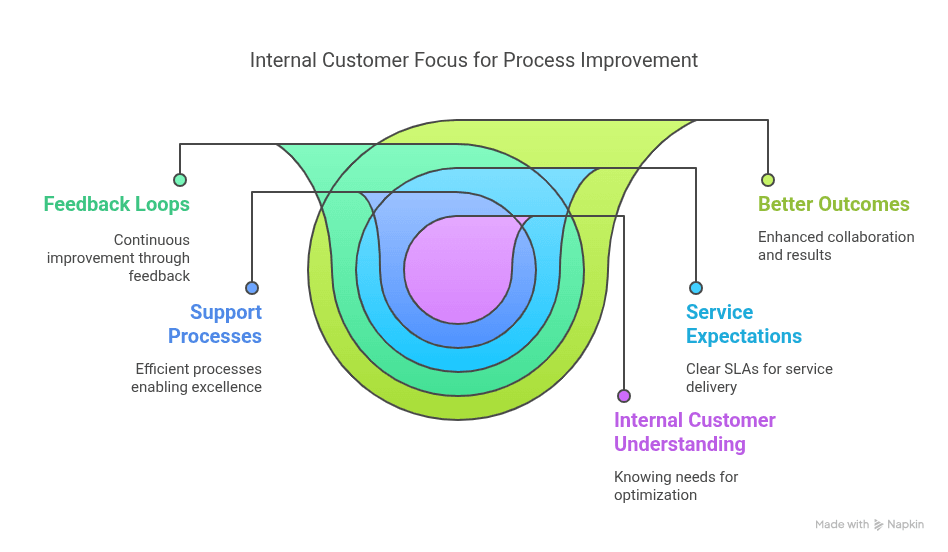
Understanding who your internal customers are — and what they need — is an essential step in process improvement. It allows organizations to optimize workflows, minimize bottlenecks, and design support processes that truly enable operational excellence.
Across departments and industries, internal customers tend to expect the same four things:
- Clarity — knowing exactly how to request a service and what information to provide.
- Predictable response times — a known deadline, even if it isn’t immediate.
- Quality and completeness — requests resolved right the first time, without rework.
- Communication — visibility of status and proactive notice when something changes.
The most effective way to manage these expectations is to make them explicit: define internal SLAs for the services each team provides, and create feedback loops to check how well they are being met.
How to Measure Internal Customer Satisfaction
You can’t improve what you don’t measure. Four practical indicators cover most situations:
- Internal CSAT surveys — short satisfaction surveys after a request is completed.
- SLA compliance rate — the percentage of requests resolved within the agreed time. Learn how to calculate it in our guide to the service level formula.
- Cycle time — how long internal requests actually take, end to end.
- Rework rate — how often requests bounce back for corrections or missing information.
Internal Customers & Shared Services: Taking Service Excellence to the Next Level
Recognizing the importance of internal customers is the first step. But to truly deliver high-quality service internally, organizations need structure, consistency, and focus. That’s exactly what Shared Services Centers (SSCs) offer.
What is a Shared Services Center?
An SSC centralizes support functions like HR, IT, Finance, Procurement, and others, to serve multiple departments across the organization. Instead of each business unit handling these services independently, the SSC becomes a dedicated internal service provider.
Why SSCs are the Ultimate Expression of Internal Customer Focus:
✅ Service Agreements (SLAs): SSCs formalize expectations with clear service level agreements, ensuring internal customers know what to expect.
✅ Process Standardization: Repetitive activities are mapped, optimized, and standardized, reducing friction and variability.
✅ Efficiency & Automation: SSCs leverage automation to streamline internal requests, speeding up responses and freeing people from manual tasks.
✅ Customer-Centric Mindset: Teams in SSCs are trained to treat internal departments as valued clients, focusing on responsiveness and quality.
Example in Action:
Imagine an HR Shared Services Center managing all employee onboarding requests. Instead of HR teams in different branches reinventing the wheel, the SSC provides a standardized, efficient, and measurable service for all business units.
The result?
- New hires are onboarded faster.
- Managers get real-time visibility of request status.
- Internal satisfaction improves — and so does overall company performance.
Bottom Line:
Shared Services Centers elevate internal customer service from an informal courtesy to a strategic business capability.
They ensure that internal processes are not only efficient but also customer-focused, fostering a culture of collaboration and continuous improvement.
To go deeper, read our complete guide to shared services centers and see real shared service center examples. If you are weighing whether to build an internal team or hire an external provider, our comparison of shared services vs outsourcing breaks down when each model works best.
👉 Learn how SSCs can transform your internal service delivery:
Explore Shared Services with HEFLO
Conclusion
Ultimately, an internal customer is not just a passive recipient of services. They are active contributors to the value creation process. Investing in their satisfaction is not just good practice — it is a foundational element of modern, process-driven organizations.
👉 If you're interested in how internal customers connect to broader process categories, be sure to read our article "Understanding Primary, Support, and Management Processes."
FAQ: Internal Customers
What is an internal customer, in simple terms?
An internal customer is anyone inside your organization who depends on your work to do their own job. If a colleague, team, or department is waiting on something you produce — information, an approval, a service — they are your internal customer.
What are examples of internal customers?
HR is an internal customer of IT when a new hire needs accounts and equipment. Marketing is an internal customer of Finance when it needs a budget approved. Sales is an internal customer of Legal when a contract needs review. Any team receiving a service from another team fits the definition.
What is the difference between internal and external customers?
External customers buy your products or services and pay with money. Internal customers are colleagues and departments that receive services, information, or support from other teams and “pay” indirectly through shared goals and budgets. Poor external service costs revenue; poor internal service costs speed, quality, and morale — and eventually shows up in the external customer experience.
What is internal customer service?
Internal customer service means applying the same standards you use with paying customers — clear expectations, agreed response times, quality, and communication — to the colleagues and departments that depend on your team. It is often formalized through internal service level agreements (SLAs).
How do you measure internal customer satisfaction?
The most common approaches are short internal CSAT surveys after requests are completed, SLA compliance rates, end-to-end cycle time of internal requests, and rework rates. Together they show whether internal customers are being served quickly, correctly, and predictably.
Why are internal customers important?
Because external quality is assembled internally. Every product or service delivered to a paying customer is the result of a chain of internal handoffs. When those handoffs are slow or unreliable, the external customer feels it — in delays, errors, and inconsistent experiences.