Shared Services vs. Outsourcing (BPO): Key Differences and When to Use Each

Shared services and outsourcing both consolidate support processes, but they differ in ownership. A shared services center (SSC) is an internal unit owned and staffed by the company, while outsourcing (BPO — Business Process Outsourcing) transfers processes to an external provider. Shared services maximize control; outsourcing maximizes speed and cost variability.
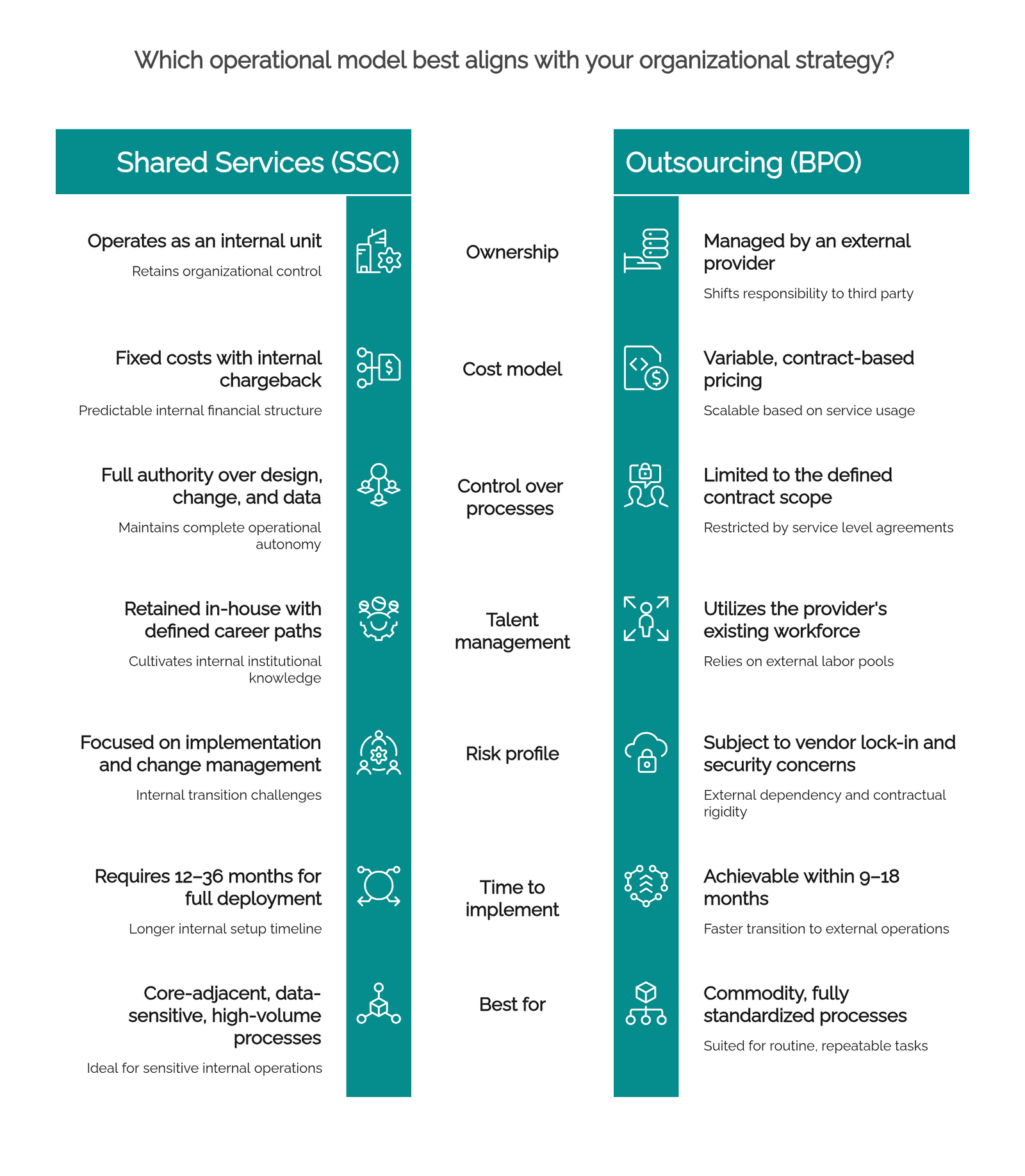
| Dimension | Shared Services (SSC) | Outsourcing (BPO) |
|---|---|---|
| Ownership | Internal unit | External provider |
| Cost model | Fixed + internal chargeback | Variable, contract-based |
| Control over processes | Full (design, change, data) | Limited to contract scope |
| Talent | Retained in-house, career paths | Provider's workforce |
| Risk | Implementation + change management | Vendor lock-in, data/security, reduced contractual flexibility |
| Time to implement | 12–36 months | 9–18 months |
| Best for | Core-adjacent, data-sensitive, high-volume processes | Commodity, fully standardized processes |
Both models are mature and battle-tested: according to the Deloitte Shared Services Handbook, over 80% of Fortune 500 companies have implemented some form of shared services in the US, and companies such as BP, Shell, Pfizer, Procter & Gamble and Oracle have proven that global shared service structures deliver measurable financial and operational benefits. The priority behind both models hasn't changed either: in SSON's State of the Shared Services & Outsourcing Industry Global Market Report 2025, cost and efficiency remain the number-one strategic target, cited by 90% of the 350+ executives surveyed in Q4 2024. The real question for operations leaders in 2026 is not whether to consolidate support processes, but which delivery model — internal, external, or hybrid — fits each process.
What is the difference between shared services and outsourcing?
The difference between shared services and outsourcing is ownership and governance, not location. A shared services center can sit offshore and remain shared services; a BPO operation can sit in the same city as headquarters and remain outsourcing. What changes is who owns the process, the people, and the data.
A shared services center operates as an internal customer service business. As the Deloitte Shared Services Handbook puts it, an SSC is not a centralized head-office function: it charges business units for the services it provides (chargeback) and formalizes the relationship through service level agreements (SLAs) that specify cost, time and quality measures. The company keeps full authority over process design, process change and the underlying data.
Outsourcing, by contrast, transfers execution to an external provider under a commercial contract. The provider owns the workforce and the delivery infrastructure; the client's control is limited to whatever the contract scope and its SLAs define. Shared services is also distinct from simple centralization — moving work under corporate without a customer-supplier relationship — a distinction covered in depth in our guide to centralization.
In one sentence: shared services keeps the process inside the company and runs it like a business; outsourcing moves the process outside the company and manages it like a contract.
When should you choose shared services?
Shared services is the right model when control, data sensitivity and continuous improvement matter more than speed of setup. Choose an internal shared services center when most of these criteria apply:
- The process handles sensitive or regulated data. Financial records, employee data and tax information often carry compliance constraints that make external transfer risky or outright impossible.
- You have internal scale. If transaction volumes across business units are high enough, consolidation captures most of the labor-arbitrage benefit a provider would offer — without paying the provider's margin.
- The process needs continuous improvement and business proximity. An SSC keeps process knowledge, improvement gains and career paths in-house.
- You plan to evolve toward Global Business Services. A captive SSC is the natural foundation for a multi-function GBS organization.
The dominant pattern documented by Deloitte is "captive first": companies build their own SSC, standardize and stabilize processes internally, and only then re-evaluate whether parts of the operation should be outsourced. That is exactly the sequence companies like BP, Shell, P&G and Oracle followed when scaling shared services globally.
Accounts Payable is the classic example of a process that stays in the SSC — in fact, it is the most common shared services process of all: Deloitte's 2023 Global Shared Services and Outsourcing Survey found that 95% of organizations deliver Accounts Payable through their shared services centers. The flow is high-volume and transactional — supplier invoice received, payment request submitted, analysis and 3-way match against purchase order and goods receipt, manager authorization above a threshold, scheduled payment execution — but it demands tax compliance, ERP integration and audit trails at every step. That combination of volume plus data sensitivity is precisely the shared services sweet spot.
Shared services is the right choice when the process is close to the core, the data cannot leave the company, and long-term ownership of improvements is worth a longer implementation.
When should you choose outsourcing (BPO)?
Outsourcing is the right model when speed, scalability and cost variability matter more than control. Choose a BPO provider when most of these criteria apply:
- The process is a commodity. It is fully standardized, well documented, and offers no competitive differentiation.
- You lack internal scale. Below a certain volume, an internal center never reaches the unit costs a specialized provider achieves across dozens of clients.
- You need speed. According to the Deloitte Shared Services Handbook, outsourcing implementations typically take 9–18 months versus 12–36 months for a captive SSC, because the provider leverages existing infrastructure, recruitment capability and implementation experience.
- Demand is seasonal or volatile. A contract-based cost model absorbs peaks that a fixed internal headcount cannot.
The drivers behind outsourcing are also shifting. In SSON's 2025 Global Market Report, executives rank access to talent and skills as the top outsourcing benefit (63%), ahead of cost and efficiency (57%) — evidence that in 2026, BPO is as much a skills play as a cost play.
The trade-offs are real. The same handbook flags the recurring concerns companies raise about outsourcing: reduced contractual flexibility once the deal is signed, people and reputational impacts of transferring roles to a provider, and data security exposure. The BPO market itself is segmented — global full-service providers, offshore full-service providers, ITO/BPO specialists and niche players — and vendor selection is a project in its own right.
Supplier registration is a typical BPO candidate: high volume, clear validation rules, low strategic differentiation. Collecting supplier documentation, verifying registration data and loading approved records into the ERP is exactly the kind of stable, rules-based work an external provider can run at scale.
Outsourcing is the right choice when the process is standardized commodity work, internal scale is missing, and time-to-savings outweighs the loss of direct control.
Can you combine shared services and outsourcing? The hybrid model
Yes — and for most large organizations, the hybrid model is the end state. Outsourcing is already part of the delivery mix for roughly half of shared services organizations, according to SSON's 2025 Global Market Report — but rarely as the whole model. In a hybrid model, the company keeps core-adjacent and data-sensitive processes in a captive shared services center and outsources commodity, fully standardized processes to a BPO provider, all under a single governance layer. A common configuration documented by Deloitte pairs offshore BPO delivery with a captive centre of excellence onshore or nearshore — locations like Prague and Budapest became reference hubs for exactly this reason.
The clearest articulation of the hybrid logic comes from Pfizer:
"Creating a hybrid model — which means a combination of shared services and a BPO provider — can add tremendous value to your organisation. To get it right, you need to understand what should go direct to your BPO provider and what should remain in house, because you shouldn't send poor processes over the wall. Once a process is commoditised, we take it offshore." — Nigel Coffey, Service Delivery Director, Pfizer (Deloitte Shared Services Handbook)
The sequence matters: standardize and stabilize first, inside the company, then move the commoditized work out. When a hybrid structure spans multiple functions — finance, HR, IT, procurement — under one governance and service management umbrella, it typically evolves into Global Business Services (GBS), the organizational model that integrates captive centers and providers into a single service delivery network — and the destination most of the industry is heading toward: 85% of shared services organizations are operating as, transitioning to, or committed to adopting GBS, per SSON's 2025 Global Market Report.
A Service Desk illustrates the hybrid split within a single service: tier 0 (self-service) and tier 1 (first-response) support are outsourced to a provider handling volume, while tier 2 — where ITIL Incident Management and Change Management touch critical systems and internal data — remains with the captive team.
The hybrid model is not a compromise between shared services and outsourcing; it is the deliberate assignment of each process to the delivery model it fits best.
What about insourcing vs shared services?
Insourcing is the reverse move: bringing previously outsourced processes back in-house. Companies insource when a BPO contract underdelivers on quality, when data or compliance requirements tighten, when costs creep past the business case, or when a process turns out to be more strategic than assumed at signing.
Insourcing and shared services are not competing options — the shared services center is usually the organizational destination of insourcing. Repatriated processes rarely return to scattered business units; they land in the SSC, where the company can rebuild standardization, measure performance through SLAs and capture the improvement gains the provider used to keep.
In short: insourcing is the decision to bring a process back; shared services is where that process goes.
How do you decide? A 6-filter sourcing decision checklist
The most reliable way to route each process is to run it through the "Fit & Ready" filters from the Deloitte Shared Services Handbook. Ask, for every process in scope:
- Regulatory and compliance constraints? Legal or fiscal requirements may prohibit moving the process externally — or even out of the country.
- Does it require face-to-face interaction? Processes that depend on physical presence resist both consolidation and outsourcing.
- Is it a strategic or competitive differentiator? Differentiating processes stay close to the business; commodities can move.
- Does it require specialist skills? Scarce expertise may argue for a captive centre of excellence rather than a provider.
- Is the process stable and standardized? Unstable, undocumented processes are not ready for any sourcing move.
- Does it run on common technology? Fragmented systems raise the cost of both consolidation and transfer.
Whatever the answers, the Deloitte handbook is explicit that the underlying principles are the same in every model: standardisation, consolidation, reengineering and automation. And in practice, filter 5 is the one that kills the most sourcing decisions: you cannot outsource — or consolidate — a process nobody can describe. An undocumented process sent "over the wall" simply locks its chaos into a contract.
Not sure your processes are ready for either model? Take the Shared Services Adoption Assessment — a quick diagnostic of process readiness before you commit to a sourcing path.
Frequently asked questions
Is shared services the same as outsourcing?
No. A shared services center (SSC) is an internal unit owned by the company, while outsourcing transfers processes to an external provider. Shared services retain full control over data, talent and process design; outsourcing trades control for lower cost and faster scaling.
What is the difference between BPO and shared services?
Business Process Outsourcing (BPO) means contracting an external provider to run a process end to end. Shared services means consolidating the process in an internal unit that serves multiple business units under service level agreements (SLAs). The difference is ownership and governance, not location.
Is shared services cheaper than outsourcing?
Not always. Outsourcing usually delivers faster cost reduction through provider scale and labor arbitrage, while shared services deliver larger long-term savings once the center matures, because the company keeps process improvements and avoids provider margins.
How long does it take to implement shared services vs outsourcing?
According to the Deloitte Shared Services Handbook, shared services projects typically take 12 to 36 months to implement, while outsourcing implementations take 9 to 18 months, because the provider leverages existing infrastructure, recruitment capability and implementation experience.
Can a company use both shared services and outsourcing?
Yes. In a hybrid model, companies keep data-sensitive and core-adjacent processes in an internal shared services center and outsource commodity, fully standardized processes to a BPO provider, under a single governance layer — often evolving into Global Business Services (GBS).
Should I standardize processes before outsourcing them?
Yes. Outsourcing an undocumented, non-standardized process transfers the chaos to the provider and locks it into the contract. As Pfizer's service delivery leadership puts it, you shouldn't send poor processes over the wall — document and standardize first, then decide what to keep in-house and what to outsource.
Standardize first — whichever model you choose
Every path through the sourcing decision — captive SSC, BPO, hybrid, or insourcing — starts at the same place: processes that are documented, standardized and measurable. That work does not require an IT project. With HEFLO, your process analysts map every process in BPMN and put the workflows into production themselves — no code, no dependency on IT. Requests, approvals and handoffs move out of spreadsheets and email into a traceable workflow, giving you the baseline visibility any sourcing decision demands. And with deadlines per step and SLAs captured automatically from the running process, you get the same contractual discipline a BPO provider would impose — inside your own operation.
Ready to build the shared services foundation? Start a free trial or book a demo.