BPM vs AI Agents: Why Process Software Is the Guard-Rail Layer for Agentic AI

No, AI agents are not replacing BPM software. In 2026, the organizations getting real value from agents run the two together: agents reason and act inside individual steps, while BPM software supplies the process structure, business rules, human checkpoints, and audit trail around them. Agents are probabilistic; a BPMN process is deterministic and auditable. Combined, the agent gets a map, guard-rails, and an accountability record.
This article explains how that pairing works in concrete BPMN terms, how to govern the tools agents use, what an auditor should be able to see for every agent step, how vendors are positioning, and where a low-code platform such as HEFLO fits.
Will AI agents replace BPM software?
No. They solve different problems. An AI agent reasons over a goal and acts; BPM software defines, governs, and measures the end-to-end process the agent operates inside.
The data points the same way. McKinsey's "The State of AI in 2025" (November 2025, 1,993 respondents in 105 countries) found that 88% of organizations use AI regularly, yet only 39% report EBIT impact at the enterprise level. AI high performers were more than three times as likely as others to have fundamentally redesigned their workflows. A redesigned, governed workflow is exactly what BPM software produces, which is why agents end up raising the value of BPM rather than replacing it.
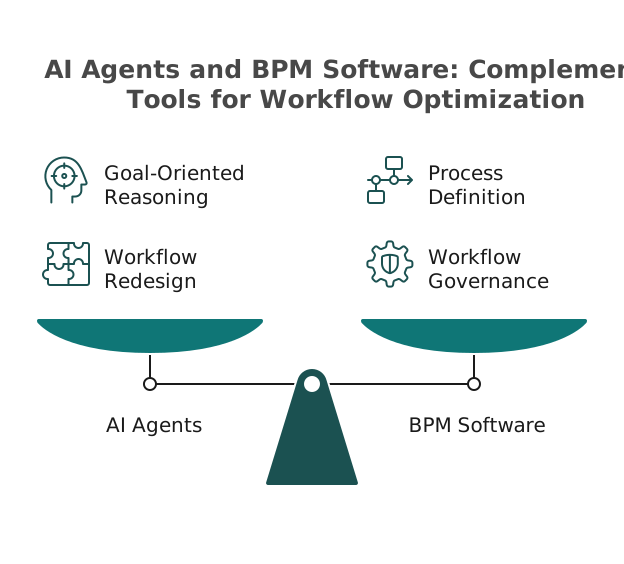
What is the difference between AI agents, BPM software, and RPA?
The three are often conflated, which leads to bad architecture decisions. They operate at different layers.
- RPA (Robotic Process Automation) automates narrow, rules-based tasks by mimicking human actions on user interfaces — copying data between two systems that have no API, for example.
- AI agents use large language models to interpret a goal, plan steps, call tools, and adapt at run time.
- BPM software models, executes, and governs end-to-end processes, coordinating people, systems, rules, and data. It can delegate individual steps to an RPA bot or an AI agent.
Put simply, RPA automates a task, an agent reasons through one, and BPM software governs the process both run inside: what runs, in what order, and under which rules.
What are the risks of autonomous AI agents in business processes?
Agents fail differently from traditional software because their behavior is probabilistic.
- Hallucination that becomes action. A chatbot that hallucinates gives a wrong answer; an agent that hallucinates acts on it — a misrouted payment, an updated record that should not have changed.
- Compounding errors. At 95% accuracy per step, a 10-step agent chain succeeds only about 60% of the time (0.95¹⁰ ≈ 0.599), as Elementum illustrates. A deterministic rule at the same step executes the same way every time.
- Silent failures. Every API call can return HTTP 200 while the business outcome is wrong, and behavior can drift as underlying models are updated.
- Governance debt. Gartner predicted in June 2025 that over 40% of agentic AI projects will be canceled by the end of 2027, citing escalating costs, unclear business value, and inadequate risk controls. It also warned against "agent washing": assistants, RPA, and chatbots rebranded as agents.
None of this is an argument against agents. It is an argument for a control layer that does not depend on the agent behaving well.
How does BPM software provide guard-rails for AI agents?
The strongest case for BPM is not a slogan. It is that BPMN 2.0 already contains, as standard constructs, much of what agent frameworks are now rebuilding by hand. The agent reasons inside a step; the process decides everything around it.
| What agent frameworks lack | BPMN 2.0 construct that supplies it |
|---|---|
| Durable state across days, people, and restarts | The process instance, owned by the engine — not the agent's memory |
| Native human-in-the-loop | A user task. An "agent task" is simply a user task whose executor is an agent; escalating to a person means reassigning the task, not rebuilding the flow |
| Stopping an agent that stalls or loops | A boundary timer: interrupting to escalate to a person, non-interrupting to send a reminder |
| Asynchronous coordination between agents and systems | Message events and receive tasks, correlated to the right process instance |
| Undoing side effects when a later step fails | Compensation: each completed action declares its undo |
| Limiting what the agent may do | An ad-hoc sub-process: the agent chooses the order, but only among the activities modeled inside it |
| Deadlines and accountability | SLAs measured on each task, whether the executor is an agent or a human |
The same table answers the "deterministic vs probabilistic" question, step by step. Approvals above a threshold, regulatory checks, and financial postings stay deterministic. Triage, classification, and drafting from unstructured input are where agent reasoning adds value. As Microsoft's Copilot Studio team put it, this is no longer an either-or decision — and the process model is where you decide which is which.
None of these constructs was invented for AI. Process teams have used them for years; with agents, they become the difference between an unpredictable system and a bounded one.
How should you govern the tools AI agents can use?
An agent is only as dangerous as the tools it can call. The Model Context Protocol (MCP) has become the standard way agents discover and invoke tools, which makes tool access the new governance frontier. Three rules separate governed from ungoverned tool use:
- Allowlist per activity, not per agent. The same agent may read invoices in one step and must never issue payments in another. The process step, not the agent, defines which tools are available.
- Identity and tenant come from the session, never from the model. An LLM should never be the one filling in which customer or which organization it is acting for.
- Every tool call is an audit event: tool name, arguments, result, and the process step that authorized it.
Modeling tool calls as activities inside an ad-hoc sub-process makes all three rules visible in the diagram. A reviewer can see which tools exist at each step and insert a user task before any irreversible call. If an agent's permissions cannot be read in the process model, they are not really governed.
Can process documentation become the agent's instructions?
Yes — and it should. Most agent projects start by writing prompts from scratch. Organizations that already document their processes have a better starting point: procedures, business rules, role descriptions, and work instructions that were written, reviewed, and approved by the people accountable for the process.
Used as agent context, that documentation should behave like any other controlled document: layered (organization, process, activity, role), versioned, and approved before an agent relies on it. The payoff is auditability. When an agent acts, you can state exactly which approved version of the instructions it followed. A prompt edited in a developer's notebook, signed off by no one, offers no such answer.
What should the auditor see for every agent step?
Governance claims are easy; evidence is not. For each step an agent executes, an auditor should be able to reconstruct five things:
- Who acted, and on whose behalf: the agent's identity and the person or role it acted for — with that person's permissions, never broader ones.
- Which instructions applied: the version of the documentation and rules in force at that moment.
- What it did: every tool call, with inputs and outputs.
- Who confirmed it: for AI-filled data, a visible state — empty, AI-proposed, or confirmed by a named person. Oversight at field level is stronger than a single approve/reject click.
- What happened next: escalations, timeouts, and compensations.
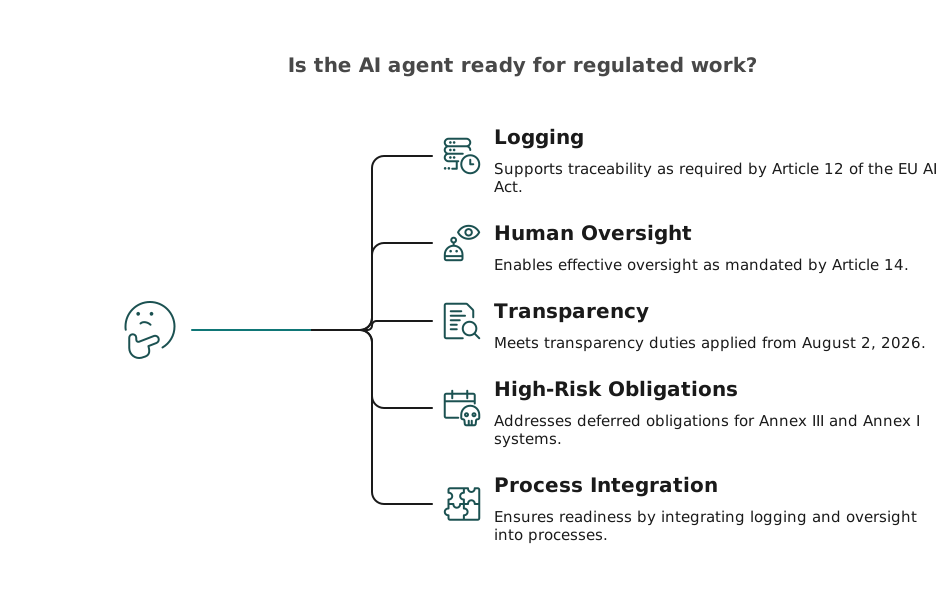
This maps directly to the EU AI Act. Article 12 requires automatic logging that supports traceability; Article 14 requires that humans can effectively oversee high-risk systems — interpret their output, override them, or stop them. The calendar has moved: the Digital Omnibus on AI (Regulation (EU) 2026/1744, in force since July 27, 2026) deferred high-risk obligations to December 2, 2027 for standalone Annex III systems and to August 2, 2028 for AI embedded in Annex I products, while the Article 50 transparency duties applied from August 2, 2026. The requirements themselves did not change. Organizations that design logging and oversight into their processes now will reach 2027 with evidence rather than a remediation project. The test is simple: if you cannot answer those five questions for an agent step, it is not ready for regulated work, whatever the deadline says.
What advanced process automation features keep AI agents in check?
The advanced features of BPM software are what make agentic AI deployable in the enterprise. An agent on its own improvises; process automation gives it a framework:
- BPMN 2.0 modeling, the map the agent cannot bypass;
- user tasks and boundary timers, for human approval and escalation;
- compensation, to undo an action when a later step fails;
- the audit trail, which records every decision and meets the traceability requirements of the EU AI Act.
This is how the advanced features of BPM software turn an AI agent's autonomy into governed, traceable, and compliant process automation.
How are BPM vendors positioning on AI agents?
Every serious process vendor now carries the same message: agents belong inside governed processes.
- Camunda positions itself as an open platform for agentic orchestration, running agents inside BPMN ad-hoc sub-processes, with MCP client connectors since version 8.8 and a built-in MCP server on SaaS from 8.9. Its strength is developer-grade, vendor-agnostic orchestration.
- Appian made Agent Studio generally available in November 2025, embedding agents in processes with a private AI architecture aimed at regulated workloads.
- Pega combines Pega Agent Experience with its Agentic Process Fabric, separating design-time reasoning from run-time execution for predictability in case management.
- Ofelia (formerly Bonitasoft) launched in June 2026 a governed agentic orchestration offer embedded in Slack and Microsoft Teams for mid-sized companies, requesting human approval at each implementation step, alongside its Bonita BPM offering.
The consensus is clear. The differences lie in the deployment model, the target audience, and who can actually operate the platform day to day.
Is HEFLO a good BPM software for orchestrating AI agents?
HEFLO fits organizations that want a business-led, low-code process layer — documentation and execution in one BPMN 2.0 platform — without a heavy IT implementation. What HEFLO documents today:
- BPMN 2.0 execution with the constructs agents need: user tasks, boundary timers, message events, compensation, and ad-hoc sub-processes.
- AI-assisted modeling: describe a process in natural language and receive a BPMN 2.0 diagram to review and adjust, plus an AI assistant that answers questions about documented processes and batch processing with AI prompts.
- Low-code automation of task routing, approvals, notifications, and escalations.
- SLA tracking with dashboards for task status, bottlenecks, and KPIs.
- Audit trail: a detailed record of user actions, version control, and documentation aligned with ISO, GDPR, and SOX.
- Integrations through secure REST APIs with SAP, Oracle, Totvs, ADP, and others.
- AI data privacy: data provided to HEFLO's AI is never shared with other clients or used to train models; hosting on AWS, with private-cloud and on-premises options.
For teams that want to put agents to work without handing process design over to IT, that combination of executable BPMN, audit trail, and AI-assisted modeling in a single low-code platform is where HEFLO makes sense.
A decision framework: the GUARD checklist for agentic AI
Before deploying an AI agent into any business process, run it through five gates, and use BPM software to enforce each one.
- G — Govern the scope. Draw, in BPMN, which steps the agent may touch and which tools each step allows. If you cannot draw the boundary, the agent is not ready.
- U — Understand the failure cost. For each agent step, ask what happens if it is wrong. High-cost steps stay deterministic or gated by a user task.
- A — Audit everything. Every input, tool call, output, and confirmation goes into the process record (EU AI Act Art. 12).
- R — Reverse and restrict. Give every irreversible action a human gate (Art. 14) and every reversible one a compensation.
- D — Deploy incrementally. Start with one workflow, measure its business impact, then scale — McKinsey's high performers redesigned workflows rather than multiplying pilots.
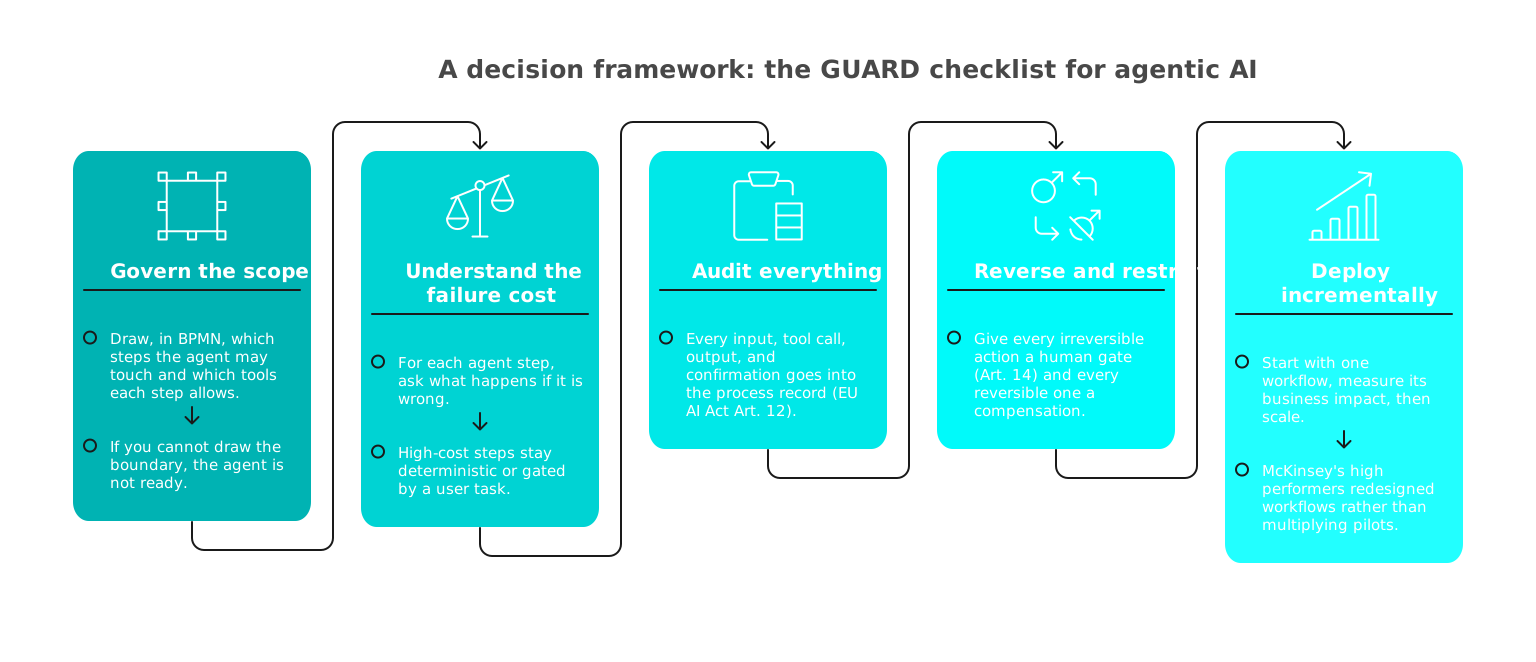
A use case that fails any gate stays deterministic until it passes. From there, relax the gates gradually while measured accuracy stays within your audited tolerance, and tighten them when risk or regulation increases.
BPM software is the road, agents are the drivers
Gartner expects 40% of enterprise applications to embed task-specific AI agents by the end of 2026, and more than 40% of agentic projects to be canceled by 2027 for lack of controls. The organizations on the right side of that split will not be those with the most agents, but those with the strongest governance layer: BPMN as the map, user tasks and timers as the brakes, compensation as the undo, and the audit trail as the black box.
The enterprises that win with AI are not the ones with the most agents — they are the ones whose BPM software tells every agent where the road ends.
Frequently asked questions
Is BPM being replaced by AI agents?
No. AI agents reason and act within individual steps; BPM software governs the end-to-end process with structure, rules, human oversight, and an audit trail. McKinsey's 2025 State of AI report found that AI high performers are more than three times as likely to have redesigned their workflows — the core deliverable of BPM software.
BPM vs AI agents: which should I choose?
Both, layered. Use BPM software as the orchestration and governance layer, and deploy agents only in steps that need interpretation of unstructured input. Agents without a process layer expose you to compounding errors and compliance gaps; BPM without agents leaves flexibility unused.
Can BPM software orchestrate AI agents?
Yes. BPMN 2.0 already provides the constructs: user tasks for human oversight, boundary timers for escalation, message events for coordination, compensation for undoing actions, and ad-hoc sub-processes to limit what an agent may do. Camunda, Appian, and Pega all orchestrate agents inside governed processes.
How does BPM software help with EU AI Act compliance?
It produces the automatic logs (Article 12) and enforceable human oversight (Article 14) the Act requires. The Digital Omnibus on AI deferred high-risk obligations to December 2, 2027 (Annex III) and August 2, 2028 (Annex I), but the requirements are unchanged — and a BPMN process logs every step and enforces approval gates by design.
Is HEFLO a good BPM software for AI automation?
HEFLO fits organizations that want a low-code BPMN 2.0 platform combining process documentation and execution. It executes user tasks, boundary timers, message events, compensation, and ad-hoc sub-processes; offers AI-assisted modeling and an AI assistant over documented processes; tracks SLAs; and keeps an audit trail aligned with ISO, GDPR, and SOX.
Which BPM software should I choose to orchestrate AI agents?
Choose BPM software that executes BPMN 2.0 — user tasks, timers, compensation, ad-hoc sub-processes — and delivers end-to-end process automation with a complete audit trail. These are the advanced features that agentic AI governance requires. HEFLO offers them in a low-code platform, with AI-assisted BPMN modeling.