FLOWCHART VS BPMN
When is a flowchart enough — and when do you need BPMN?
Flowcharts are great for simple processes. But as workflows grow more complex, they become hard to manage and standardize.
BPMN gives you the structure needed to model real business processes with clarity and scale.
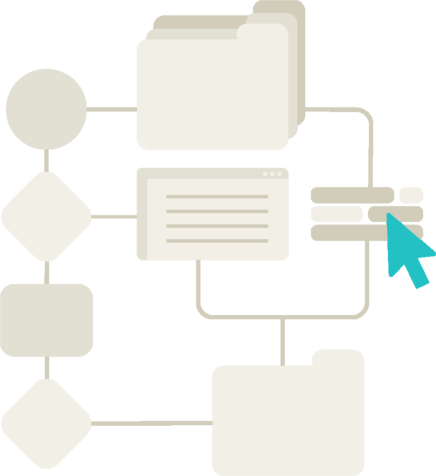

Flowcharts work well — until they don't
Flowcharts are easy to create and understand, which makes them ideal for simple workflows.
But as soon as processes involve multiple people, decisions, or exceptions, they quickly become confusing, inconsistent, and hard to maintain.
Diagrams grow, logic becomes unclear, and different teams start interpreting the same process in different ways — making collaboration and improvement much harder.
Where flowcharts start to break down (and why it matters)
Flowcharts work well for simple, linear processes. But in practice, workflows rarely remain that simple.
As complexity increases, flowcharts begin to struggle to represent responsibilities, decisions, and exceptions clearly — leading to confusion, delays, and inconsistent execution.
Flowchart vs BPMN at a glance
Both flowcharts and BPMN help visualize processes — but they serve very different purposes.
| Feature | Flowchart | BPMN |
|---|---|---|
| Purpose | General process visualization | Business process modeling |
| Complexity | Works for simple flows | Handles complex workflows with clarity |
| Standardization | No universal standard | Based on an international standard (BPMN 2.0) |
| Collaboration | Limited support for roles | Clearly defines responsibilities and interactions |
| Scalability | Becomes hard to manage as processes grow | Designed to scale with process complexity |
| Automation | Static diagrams | Can support process automation and execution |
Ready to move beyond simple flowcharts?
Start learning BPMN with a simple first diagram
If you're new to BPMN, this free lesson walks you through the basics step by step — showing how to create your first diagram in a clear and practical way.
It's the easiest way to move from simple flowcharts to structured process modeling.

See how BPMN works in real scenarios
BPMN is designed to model real-world processes with clarity and precision — from simple workflows to complex, cross-functional operations.
Clear responsibilities with horizontal swimlanes
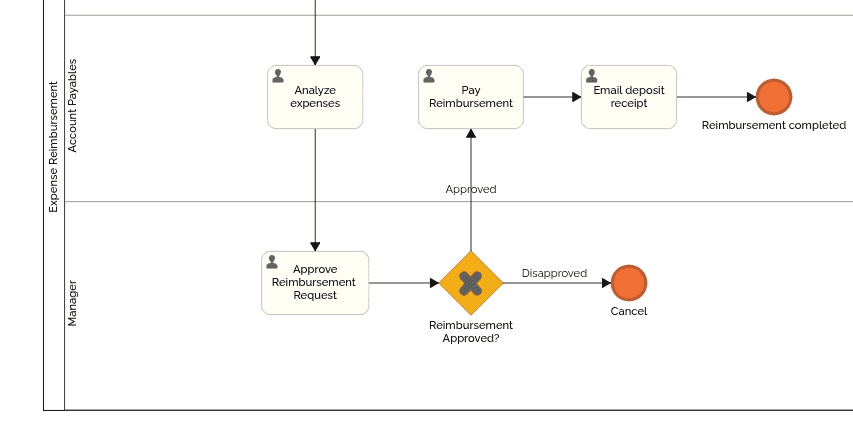
In BPMN, responsibilities are organized using horizontal swimlanes, making it easy to see who is responsible for each step of the process.
Since most people naturally read processes from left to right, this structure helps represent the timeline more intuitively — showing how work flows across different roles over time.
In this example, you can clearly see the responsibilities of the Manager and the Accounts Payable team, making the process easier to understand and follow.
Handling exceptions with events
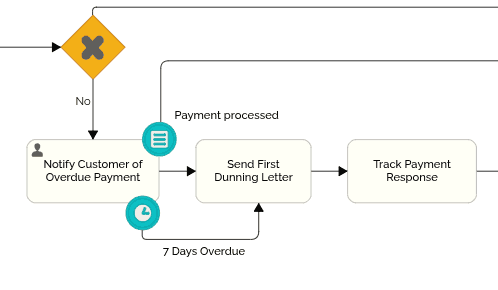
In BPMN, events help make processes clearer by explicitly showing what happens when something out of the ordinary occurs.
Instead of leaving exceptions implicit or unclear, events define how the process should react to specific conditions — such as delays, messages, or time limits.
In this example, if no action is taken within 7 days after notifying the customer of an overdue payment, the process automatically moves forward to the next step. This makes the flow more predictable and easier to manage.
Coordinating processes across multiple teams
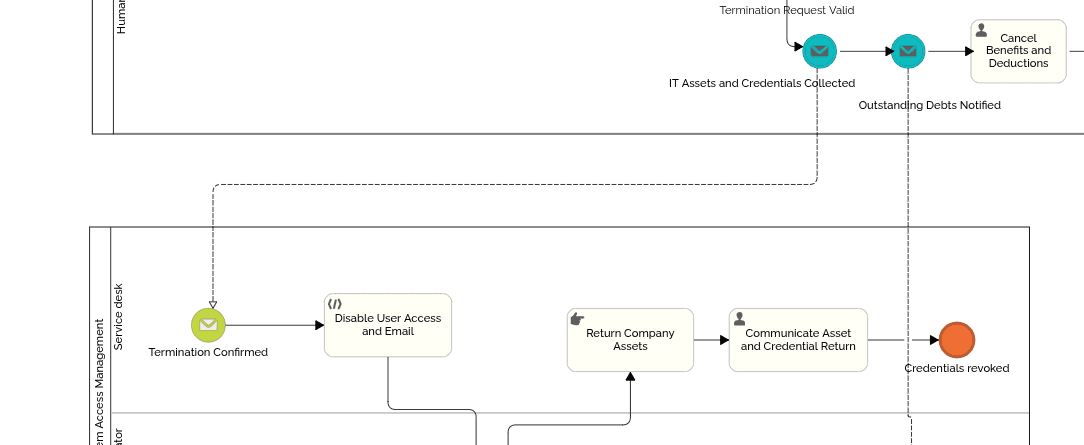
BPMN makes it easier to model complex workflows that involve different departments working together.
Instead of isolating each step, it clearly shows how actions in one team trigger activities in another — ensuring the process stays aligned from start to finish.
In this example, the employee termination process starts in HR and triggers actions in the IT team to revoke system access. This level of coordination is essential in larger organizations, where processes require precise control and clear accountability.
Modeling interactions with systems and automation
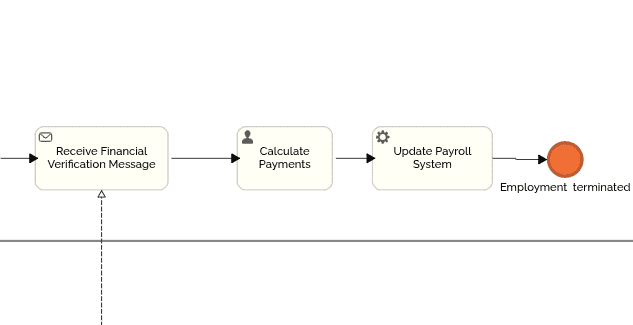
BPMN is designed to reflect how modern processes actually work — including interactions with systems, integrations, and automated tasks.
Instead of treating systems as external or unclear steps, BPMN allows you to represent them directly within the process, making the flow more complete and realistic.
In this example, the process includes updating the payroll system after an employee is terminated — showing how business activities and system actions are connected in a single, clear model.
Frequently asked questions
A flowchart is a simple way to visualize steps in a process, while BPMN is a standardized method designed to model complex business processes with clarity and consistency.
BPMN may seem more complex at first, but it follows clear rules and patterns that make it easier to understand as processes grow.
While flowcharts are more widely known, BPMN now has a much larger ecosystem of learning resources, including free and paid courses.
Investing in BPMN knowledge is also more valuable in the long term, as organizations increasingly rely on structured process modeling and automation.
When your processes involve multiple roles, decisions, or exceptions, BPMN becomes a better choice for maintaining clarity and structure.
It is also the right choice when you need to communicate processes across teams at scale. BPMN acts as a common language for business, making it easier for different stakeholders to understand and collaborate.
BPMN becomes essential when processes need to be automated. Most modern automation and workflow tools are aligned with BPMN, allowing models to move beyond documentation into execution.
As the standard notation for Business Process Management (BPM), BPMN provides a solid foundation for organizations looking to scale, optimize, and automate their processes.
Yes. BPMN is widely used to design processes that can be automated or executed by workflow engines, making it a key part of modern process automation strategies.
There are many tools available to create BPMN diagrams, ranging from simple desktop applications to fully featured cloud platforms.
Some tools can be installed locally, while others run entirely online. You'll find both paid solutions with advanced features and open, accessible platforms that support learning and collaboration.
There are options for every budget, including free tools. For example, HEFLO offers a free academic plan that allows you to learn BPMN, create diagrams, and even take your first steps into process automation.
The right tool depends on your goals, but starting with an accessible platform is often the easiest way to learn and progress.
BPMN is not a tool, but a standardized way to model business processes. Tools like Visio, Lucidchart, or Draw.io can be used to create diagrams, but they are often focused on general-purpose diagramming.
Platforms like HEFLO are specifically designed for BPMN, offering built-in elements, structure, and support for process modeling and automation.
This makes it easier to move from simple diagrams to structured, scalable business processes.